Keyboard Offsite Rig for stage and studio sessions

diagram
glamour-1
practice
stage
all
keyboards

Last Update 02-12-2026

Rack Design
The System
Stacking Keyboards
Polysynths
System Diagram
Rack Cases/Management
Effects
Cartage
MIDI Configurations
Epilogue

The bands I had performed in since 1996 didn't demand much in the MIDI department so I hadn't needed a MIDI controller for gigging. That changed in 2013 when I had joined a southern rock weekend band playing piano, EPs, Hammond, and 3rd guitar. By the time I joined the popular 70s/80s rock band Shylock Foxx in 2018 I really had to up the ante.

I've always been a systems guy and have built a few MIDI keyboard stage rigs over the years. With the different genres I have played, the required elements varied. As the years progressed with stage and studio work, I abstracted the elements needed for a stage system for whatever genre I was playing (and I've played many). There are elements common to all the genres while others required more gear.

The 70s/80s rock band placed a heavy demand on keyboards so this was an opportunity to build the last stage rig I would need (famous last words!). Since this was the genre that would maximize the gear I would need, I chose the modular approach to building the stage rig. Besides the sound sources, I planned effects into the system. With a modular system, I only take what I need for the genre, IE 80s vs blues rock.

So after many years of leading a double identity as studio rat and gigging musician, I decided to design a keyboard offsite rig with the following attributes:
I bought my Kurzweil MIDIBoard brand new back in 1989 and at the time had gigged it often. It is very reliable and very powerful. The MIDI features are well thought out and it is an essential element in any MIDI system for automating sound configurations. As my studio grew, my MIDIBoard became firmly rooted in my studio. When I last gigged with the MB it was a big hassle because of repetitive teardown and setup between studio and stage, especially at my former dwelling where the studio used to be down a flight of stairs in the basement with no ground level access!

Since all my MIDI devices can respond to MIDI volume control, I chose a simple line level mixer instead of a MIDI controlled mixer. I do not need EQ, I prefer to shape the tone at the MIDI device.

As the demands of the music grow, with a modular approach adding components is easy. Here I had to be careful to avoid two things: excess weight and excess cabling. My desire was to use rack mounted devices wherever possible and minimize external devices. Rack mounted devices reduce the setup/teardown time as most of the cabling can be prewired. I learned long ago that large racks can get heavy fast. I have to load in/out by myself. Wheels on the racks ease the job, especially since I had upgraded my cartage.

Now to find a MIDI master controller. After reviewing the crop of new MIDI controllers on the market, I found nothing that came even close to the power and feel of the MIDIBoard. There are 88 note digital pianos that can transmit MIDI, but they are not a MIDI controller that can automate sound configurations nor can they transmit MIDI on multiple channels. Frankly I was spoiled by the power, flexibility, and feel of my MIDIBoard so I opted for a 2nd "road" MIDIBoard and found one in short order on the 'bay. There were other benefits to this decision:
top

Designing the Racks
Since I would need analog polyphonic synthesizers like my Alesis Andromeda or Oberheim OB-X8/Sequential Trigon-6 for some genres, I designed the racks so they could double as a keyboard stand. To control the weight, instead of a single tall rack I chose to stack two racks of different size (8U and 12U) to distribute the weight evenly with rack mounted devices. Weight does vary per rack unit space depending on whether the device has an internal transformer (which is heavy) or is powered from an external power source.

I don't require access to the racks during performances, as they are controlled remotely over MIDI from my keyboards. For the shows where there are multiple bands requiring fast band change-outs or where we play on an elevated pavilion in a park, the racks are set offstage and only the keyboards get changed out with long cable bundles to the racks. The bottom racks have wheels for easy load in/out.

One thing that is absolutely forbidden from my stage system is "wall wart" power supplies. Wall warts made cheaper product possible - they were used as an external power source to get around UL requirements for high voltages in an enclosed box and eliminate an expensive development process. Unfortunately wall warts are unreliable and not rugged enough for the rough rigors of the road. Since I had devices that required external power sources, I eliminated all the wall warts with a Juice Goose 12Paq. The 12Paq can supply low voltage sources such as 9VDC and 12VDC (both polarities), plus 9VAC (which can be configured to supply 18VAC if you know what you're doing). I planned one rack to contain all devices requiring low voltage sources in the same rack as the 12Paq. I bought a new one for my studio years ago and it has proven so reliable that it was the optimal tool for the stage system. Today the 12Paq is no longer made so I acquired a used one which required some restoration. The power outputs are on RJ45 interconnects similar to computer network ports, and I already knew the wiring for the 12Paq so I could build my own cables.

I was looking at a diverse assortment of rack mounted devices so I planned out the racks using a spreadsheet listing weight, power source, interconnects, and size of each device. I had a total of four racks, two 8U and two 12U racks. This spreadsheet really helped to plan the weight distribution and position of each device in the racks.

Heat distribution is also a parameter I had to pay attention to when planning the racks. FEW DESIGNERS CONSIDER THIS PARAMETER. If any device generates too much heat, then it is in danger of becoming unreliable. I don't want stuff breaking down in the middle of a show. I wanted to avoid cooling fans as they can also fail.

Everybody knows that heat rises. Passive heat convection allows heat to escape by rising in open space, so it is the most reliable method of eliminating heat and maintaining reliability. The components that usually generate heat are the transformers and voltage regulators, which are almost always located at the rear of the device. The experience from building my studio taught me that arranging the rack devices with the deepest one on the bottom with shallower ones above exposed the rear of the devices to open space, achieving passive heat convection. When I couldn't get optimal arrangements, I used a vent panel between devices to create open space. This has not yet failed me.

Then there's interference between rack items, which happens less often. I found I had to avoid putting certain rack devices adjacent to each other because one of them generated enough EMI radiation (especially anything with a microcontroller or CPU) to create noise in an adjacent device.

I built the I/O panels which are arranged in each set of 8U/12U rack so that they are in close proximity when the racks are stacked. That permits interconnect cables between racks as short as possible which reduces the tangle of longer cords.

See the images below for a better illustration of the I/O panel arrangement.
jacks

without cables
proximity wo cables
with cables
proximity w cables


Security covers are used to prevent unauthorized access (believe me it does happen).

The System
Over the years of performing various genres in clubs and studios, I have abstracted the minimum ideal keyboard setup into the following:
  • weighted action 88 note master MIDI controller
  • Moog PolyPedal foot controller
  • Base Analog Rack containing mixer, MIDI router, Sysex storage/recovery/sequence playback, drums, bass synth stacked on top of
  • Kurzweil Rack containing effects processors and sound generation components for "bread-n-butter" sounds like acoustic pianos (APs), electric pianos (EPs), brass, reeds, winds, strings, tuned percussion
  • Racks are described below
controllers-basic
minimum-racks

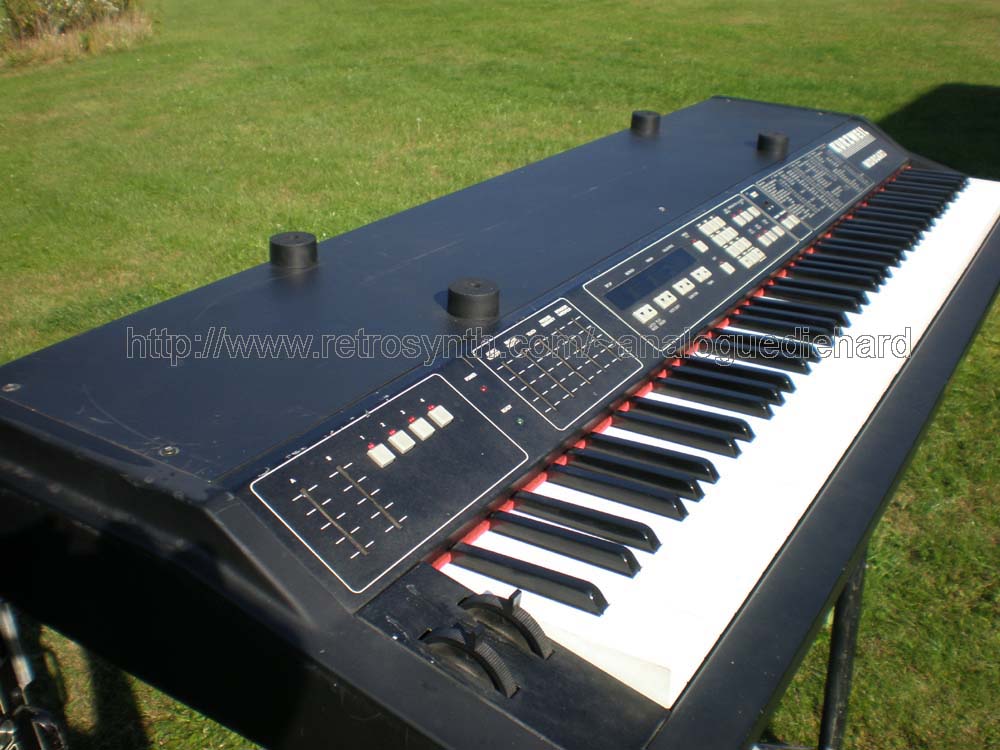
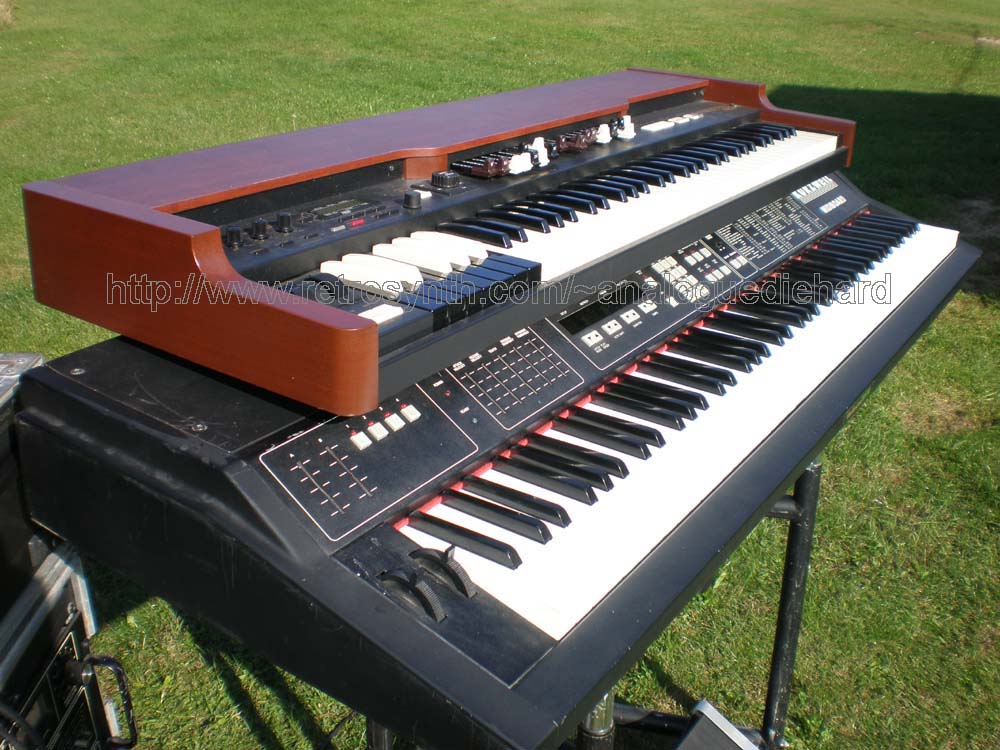
Since this was going to be a MIDI controlled system, my Kurzweil MIDIBoard was designated as the master MIDI controller. Besides a controller for playing, it can configure my entire system for each song. This would include sound patches, effects, MIDI matrix routing, etc. For each sound patch I can configure volume, variations in envelope and filter settings, etc over MIDI. The MIDIBoard also has the best feeling action I have ever played, which is important to the piano player in me.

This is the "2nd" MIDIBoard I acquired used online for road use. It had suffered a blunt impact from something which sheared off the slidepot shafts. New ones were not available, so I conjured up a solution 1) use the PolyPedal sweep pedals to replace the two "Slider A" and "Slider B" controls 2) the five "Attack Velocity", "Release Velocity", "Touch", "Pressure Sensitivity", and "Retrigger Threshold" slidepots can be programmed with each setup in the MIDIBoard.

The MIDIBoard is carted in a strong ATA compliant road case.
midiboard
midiboard-in-case
I wanted to minimize setup/breakdown time by consolidating multiple footswitches and sweep pedals used with the MIDIBoard. My Moog Polypedal hadn't seen much use as I no longer used it with the Polymoog so I decided it would be the perfect footpedal solution, as everything I needed was in one unit and it could eliminate multiple cables with a single multicore cable. Being a heavy road-rugged unit, it also doesn't slip away from your feet like individual pedals do. I rewired the PolyPedal to work with the MIDIBoard which connects through a single multiwire cable.

Even though I gigged the Polypedal since 1985 without a case, this time around I acquired a new Anvil case for it.
polypedal
polypedal


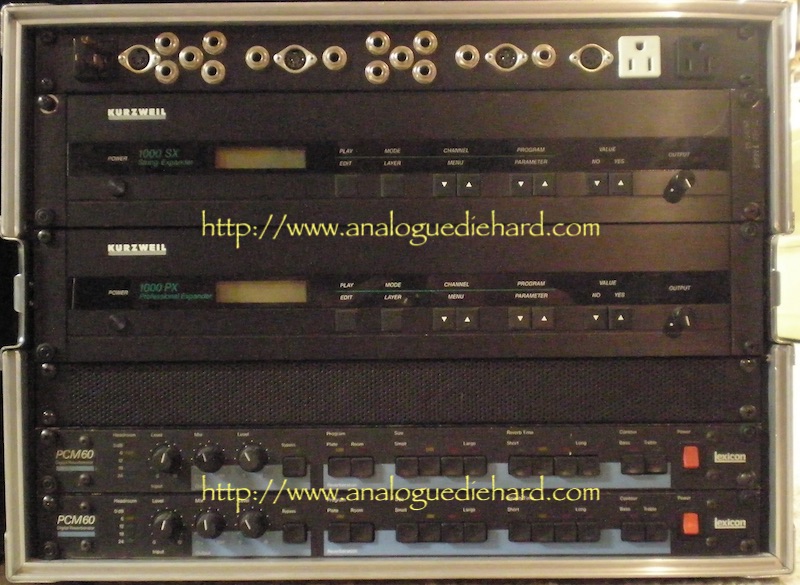
First rack on the design table is the Kurzweil Rack (aka "Bread-n-Butter" Rack) as seen above. For the "bread-n-butter" sounds (again, zero learning curve and known reliability history) I elected for the Kurzweil 1000 romplers which can also be found cheap on the used market. I bought a 2nd 1000PX to provide the percussive family sounds such as APs, EPs, guitars, basses, percussion, harps, vibes, and choirs; a 2nd 1000SX to provide strings, winds, reeds, brass, tympani, and other orchestral instruments. That's pretty darn near a complete orchestral sampler system! The 1000 units I bought did not have the latest OS so I copied the OS and soundblocks from my existing units (while I had them out of the racks, I also performed periodic replacement of the patch backup batteries). I copied the studio configurations and patches to the road units, then modified the MIDI mapping slightly for the offsite system. The new OS and soundblocks for the 1000SX actually comprises a 1000AX system, so I combined my 1000SX and 1000HX patches into a single library - this barely fit into the RAM capacity on the unit.

These boxes require reverb effects which are discussed here.
bread
                butter rack
block diagram bread butter rack

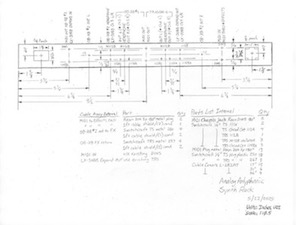
For offsite studio sessions, I designed the I/O panel on the rack to get the raw sounds without effects. I also included I/O for the digital reverbs so they were available as separate processors (for off-site studio work), and inserts so I could patch pre-delays for the reverbs. rack
                panel brean-n-butter

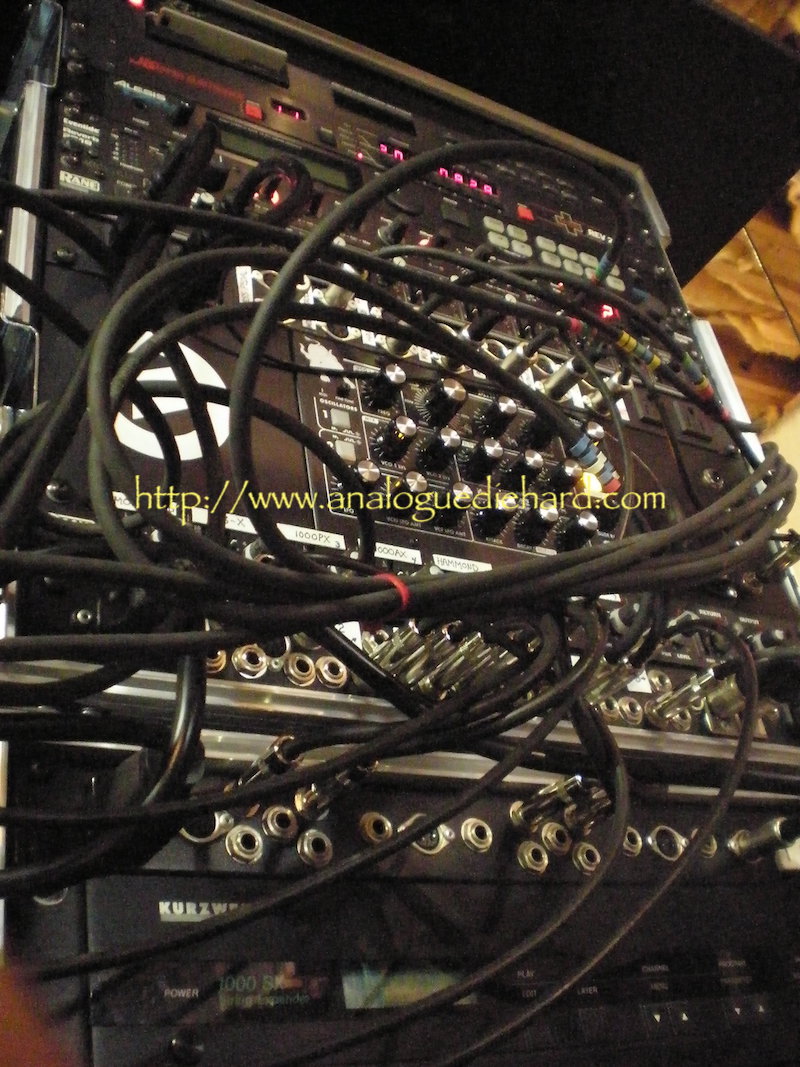
Next up is the Base Analog Rack. This is named because it is the base component for MIDI control, and since expansion was going to involve all the modules and analog synthesizers it contains the mixers for such.

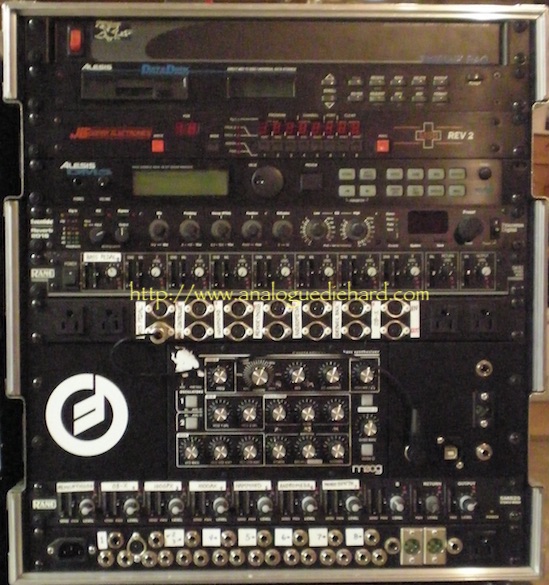
This contains the core components of the stage rig - mixers, MIDI matrix control, sequence playback (I refuse to use a laptop or mobile on stage), SYSEX backup, and module essential for rhythm. My preference for line level mixers have been Rane SM82 as they are clear & transparent, and they can be chained as your system grows. For sequence playback and SYSEX backup I chose the Alesis Datadisk - it uses floppy disks but no one has made a MIDI accessory like this with newer memory like USB sticks! Proving again that old stuff fits the bill, I use a JL Cooper MSB+ for a programmable MIDI matrix. Most of these are duplicates of my studio system, and I prefer to minimize the learning curve of new devices. Since most of these devices use external power supplies, I placed the Juice Goose 12Paq in this rack. None of the other racks have any need for external power supplies.

Components:
  • Juice Goose 12Paq (universal low voltage power supply, designed to eliminate "wall warts")
  • Alesis Datadisk (portable media MIDI backup/restore and MIDI sequence playback)
  • JL Cooper MSB+ (programmable MIDI matrix)
  • Alesis DMPro (ROMpler sound source drums and percussion with built in digital effects)
  • Rane SM82 (line level mixer, stage monitor summing)
  • Eventide 2016 (removed, replaced with Dynacord CLS-222 Leslie Simulator for the Hammond organ)
  • I/O panel, MIDI & AC distribution
  • Moog Minitaur (analog sound source for huge Taurus bass pedal sounds)
  • Rane SM82 (line level mixer, main keyboard to FOH)
  • I/O panel, main keyboard inputs, monitor output, & FOH outputs

    Minitaur output has its separate FOH send, giving the sound engineer better control to balance bass pedals and main keyboards.
rack-analog-base
This is the panel layout and wiring diagram... probably the most dense panel design I have built. Some of those jacks were a tight fit!

Basically it is the eight channel inputs for the SM-82 and the stereo L/R balanced outputs to the FOH. The EXPAND IN is for a future line mixer, and the MONITOR OUT is a summed mono keyboard output to my stage monitor, independent level from the FOH outputs.

Other than the Hammond input (channel 5) and Drums (channel 8), the SM82 mixer input jacks are TRS stereo or separate L/R jacks with Left serving as L/Mono with nothing plugged in the right input jack. It's all done through the normaling action on the jacks.; I started using TRS I/O for stereo signals between keyboards and racks which reduces cabling and setup time by half.

It has actually changed three times since its initial build. This 3rd change moved the Dynacord CLS-222 Leslie Simulator to this rack because I decided that Hammond organ should be part of the base system, not an expansion.

While I do own a real Leslie cabinet, it is heavy and bulky enough that I can't justify lugging it around unless the genre requires a lot of Hammond playing. Also a Leslie takes up stage space and requires miking. Simulating the effect of a rotating speaker is extraordinarily difficult (most simulators are adequate for guitarists but not for Hammond organ), but the Dynacord CLS-222 delivers a very convincing rotating speaker effect in a rackmount 8lb package that does not require micing. The CLS-222 has long been out of production but it is still the standard against which other simulators are measured against. I grew tired of the bulky fragile 11pin interconnect system on my Hammond organs - the connectors are breakable plastic for which no rugged metal shell replacement is available, so I designed a replacement interconnect using 3/16in TRS Switchcraft connectors which are far more reliable, and easier to integrate into this panel. The 3/16in TRS jack is not a stereo audio TRS interconnect and the smaller barrel diameter was chosen to prevent a 1/4in stereo TRS insertion.
rack-analog-base-panel

You can't perform on stage without a monitor system, so...

  • For performing on stage, I add the Moog Synamp and Bose 802 speaker.
  • For those shows involving loud guitar players, I add a 2nd Bose 802. Two 802s combined with the Synamp can easily compete with a 100w Marshall full stack.
  • The monitor system consists of the Bose 802s and 802-C companion controller unit which have proven adequate for stage use. The 802-C is a required component with the 802 speakers as it processes the signal for optimal sound reproduction in the 802 speakers - the fidelity is so good that they sound nearly equal to my home studio monitors, so my sound design in the studio translates easily to the stage. The Moog Synamp is an integrated system with four channel mixer, 10 band graphic EQ, and two 200 watt power amplifiers each with protection circuits. The Synamp was the first stage sound system designed exclusively for keyboards.
  • If I am performing left hand bass or bass guitar, then I have to add a 2x15 cabinet as the Bose 802s do not project bass frequencies very well. In this configuration, the Synamp is configured in biamp mode and both power amps are in use. The Bose 802-C controller in the Synamp rack also serves as a crossover for splitting into high and low frequencies. Although the Synamp does have an onboard crossover, it is custom tailored for the Synamp speaker cabinets which I do not have (and am unlikely to ever want as they are HUGE).
  • Some stages are too small for the Synamp and Bose speakers, so I acquired a powered QSC KW122 stage monitor. This is a very high SPL high fidelity sounding speaker.

Moog Synamp
Bose 802
QSC KW122
moog-synamp
bose
kw122

top

How do I stack extra keyboards?

I added these four rubber glides to the top of the MIDIBoard... supports-1
...for placing the Hammond XK3 on top... supports-2
The racks are designed to double as a keyboard stand. Since no one makes a tabletop keyboard support system with tiers, I had to build one. The base frame is fabricated out of 2x4 pine, and I used bare tiers from K&M.

This is an old configuration; I am currently building a new PolySynth rack to replace the Andromeda and OBX, reducing the keyboards from four to two.
keyboard tiers


This system can be expanded as the event requires:
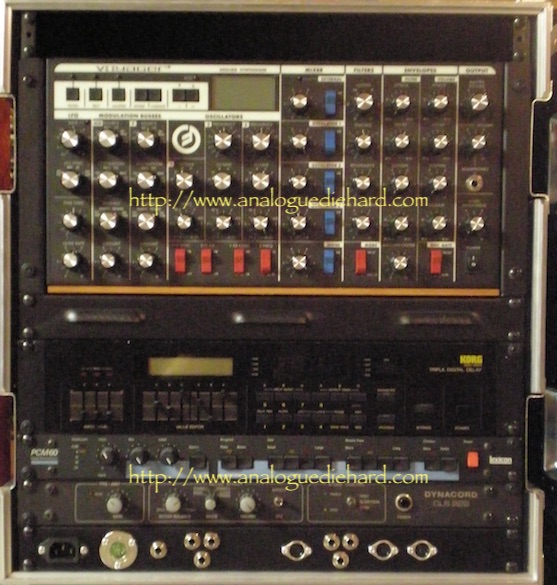
Need to add a monophonic analog synthesizer for leads and effects? That's the purpose of the Minimoog Rack:

Components:
  • Minimoog Voyager RME. This is the Rack Mount Edition (RME) of the 21st century Minimoog Voyager. I acquired this RME for a decent price from the Moog Store as a portable version of the Voyager SE I keep in my studio. Both have the Slew Rate modification which brings the tone a lot closer to my original RA Moog synthesizer.
  • Universal analog synthesizer multi-effect system.
  • Dynacord CLS-222 Leslie Simulator for the Hammond organ (moved to the Base Analog Rack).
minimoog

top

Polysynths

And finally, the 70s/80s rock band placed a heavy demand on polysynth sounds that warranted bringing them. I initially included the Alesis Andromeda and Oberheim OBX, and later eliminated the OBX when I succeeded in duplicating OBX sounds in my Andromeda. The Andromeda covers sounds from my Memorymoog and OBX, as well as secondary monosynth lead lines and many many sounds only the Andromeda can pull off. Many of the songs we play can't be accomplished by a single multi effects unit. The Andromeda has internal digital effects but were not enough. The Andromeda does have auxiliary outputs, so I route these to extra multi effects units.

Currently the Andromeda is being replaced by a pair of Oberheim OB-X8 modules and a Sequential Trigon-6 module.; I plan to configure one of the OB-X8 modules as a split module, whose L/R outputs serve the same function as the auxiliary outputs of the Andromeda.  Those outputs are routed to the Analog Polysynth Effects Rack:

Components: universal analog synthesizer multi-effect system (see below) effects universal analog

The goal of replacing the Andromeda with the OB-X8/Trigon-6 modules is to eliminate a keyboard to cart around and to bring in devices that are reliable (the Andromeda is starting to show its age by crashing in the middle of a song at least once a night).  In order to accomplish that I need a rack for the modules.  The problem is, the modules are too wide for 19in racks and because they are desktop formats they can't be mounted like a standard rack device because the rear panel jacks are such that the plugs protrude upwards and they waste rack spacing.

So I need a special "rack" built for the polysynth modules, and they will reside on sliding drawer shelves for best use of rack spacing.; When I need to develop sounds, I just pull out the module I need to edit.  While performing, the shelves are kept inside.  At the bottom of the rack, I will fill out the width for accommodating two 19in rack devices - the I/O panel (shown at the right), and the Ashly LX-308B line mixer (the only 1U line mixer comparable to the now discontinued Rane SM-82). The rack will be the same height as the 12U Minimoog rack.

On the I/O panel, the audio outputs of the "split" OB-X8 #2 were positioned to align with the input jacks of the Analog Polysynth Effects Rack - again, short audio cables & fast setup.; This I/O panel was a challenge to design.

At present I have other priorities so I have not yet built this rack.  In the interim I will be duplicating patches in the modules.
polysynth new diagram
polysynth new rack panel

top

System Diagram

This diagram of the full system shows the maximum I could conceivably need. There are certainly situations where I don't need all of this, I only take what I need. Everything I could potentially need for the stage and for any genre. IE Southern rock would not need the analog synths.

Despite the appearance, it is not that complex and it sets up easy. My interconnect cables are between 10 and 36 inches long, and for each stereo signal instead of dual cables I chose a single two conductor cable with TRS connectors. This convention speeds up setup and teardown time.

Since my keyboard duties tend to be dynamic, snakes are not a solution. I generalized audio and MIDI cables between controllers and racks into bundled sets, with separate sets for each external keyboard but not instrument specific. I designed the cable bundles to be 25ft long, for those events with multiple bands which require fast band change in/out. With the long cable bundles I just leave the racks offstage and only switch the keyboard in and out. This has worked for events like those.

Of all the stage MIDI systems I have built, these racks are actually the LIGHTEST I have put together.
diagram

top

Rack Cases & Management

One of the first racks I ever owned was a 24 space Anvil ATA rack. My initial rack system had everything pre-wired and ready to set up with absolute minimal cabling, but it was bulky and very heavy. I sold it years ago and never owned another big rack again. I came to prefer smaller racks no bigger than 12 space as they are a good compromise between minimal cabling and reasonable weight.

I refuse to buy molded rack cases. They can crack when dropped. They warp in heat and you can't secure ANYTHING to the sides (adhesive Velcro strips are not a solution). I don't like slip nuts on the rack rails, pre-tapped rails are much better. And you can't put recessed latches on a molded case.

I prefer Anvil ATA cases with recessed latches and handles (easier to pack in the cargo vehicle). Anything cheaper does not last, you get what you pay for. With the wood sides, I can secure power strips, cable ties, etc with screws. And beware of auction sellers loosely using the "ATA" tag for their cases as they are NOT ATA compliant cases.

My racks are split between studio and stage use, between recording/keyboard/FOH use. Some are multiple use racks.

Minimizing weight is an ever lofty goal of gigging.; Wheels are great for mobility but they add weight. If you are carting your gear by yourself, racks with wheels can get heavy when lifting into your truck/SUV (I have now upgraded to a better cargo system). Do not buy wheels at hardware stores, they have failed on me. Buy 3-1/2" wheels from TCH.com that can support 265lbs and have a rubber tire on cast metal wheel frame. Never had one of those fail yet.

Internal interconnect cables is another place to minimize weight. I make my own interconnects and realized I did not need rugged stage cable for internal interconnects so I opted for Canare L-2B2AT cable which is a lot lighter and easy to strip & build. I have been using the Canare cable since the late 1990s and have yet to suffer a broken cable. To minimize weight I used Switchcraft plugs with plastic shells.

If you go the DIY route for cabling, use nothing less that genuine Switchcraft and Neutrik plugs/jacks. Beware that there are "look-alike" (read: counterfeit) Switchcraft and Neutrik products on the market. I made the mistake of buying asian substitute products in bulk for making rack interconnects - big mistake. A fifth of the plugs out of the bags had the tip shorted to the sleeve because the tip solder tab had rotated to the sleeve tab during assembly at the OEM, effectively rendering it useless. I discovered as the metal shell worked loose during transit, the shell also worked the insulating tube loose which exposed the tip solder tab. Then the shell rested on the tab, shorting the tip to ground. This created an intermittent malfunction that was a PITA to track down, and I had to add insulating tape to every one of those inferior plugs to solve the problem. Do not EVER skimp on plugs/jacks.

Since I build my own I/O panels and cabling, I started using TRS I/O for stereo signals between external devices and racks which reduces cabling and setup time by half. I use Ernie Ball stereo 25K volume pedals in my studio which were the impetus for the TRS system. I left AC cords out of the cable bundles to prevent 60hz EMI from creeping into my audio signals, and my power strips don't always land in the same place.

I stopped carrying cables in drawers, they add too much weight to the rack. I use generic tool cases to pack my cables and accessories, they are lightweight and easy to carry. top

Effects

A single multi-FX box is not satisfactory in my stage work. There are songs where I alternate rapidly between piano and brass/strings and analog sounds, and separate effects are required because a single effects unit would produce audio gaps when toggling between algorithms.

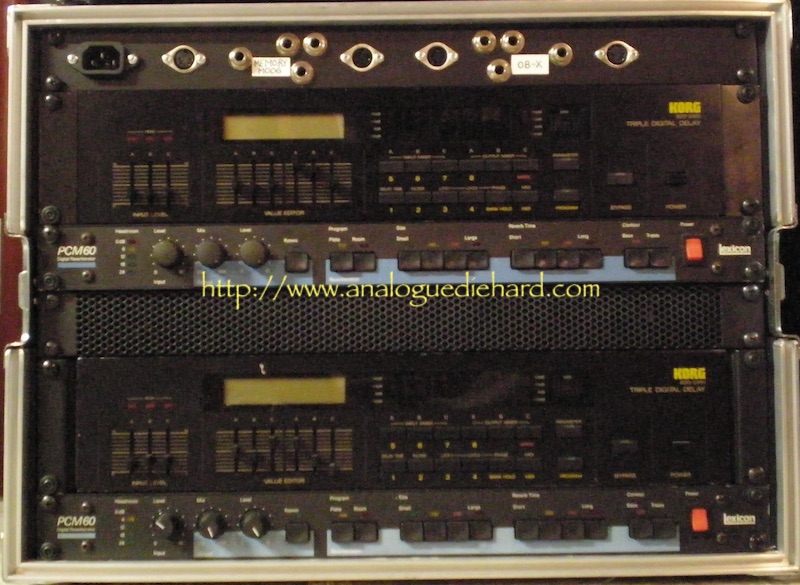
Being early generation romplers, the Kurzweil 1000 units lack DSP effects like reverb. I prefer separate outboard effects for maximum dedicated processing horsepower so I chose the Eventide 2016 for the 1000PX and the Lexicon PCM-60 for the 1000AX, which is a portable compact version of my Lexicon Model 200 studio reverb unit. The studio units are too big for the rack I had planned, and the PCM-60s are much smaller, cheaper, and simpler. Piano and percussive instruments generally work best with room reverb and strings/brass with plate reverb; so I opted for the 2016 configured to room reverb "normaled" to the 1000PX, with the PCM-60 configured for plate reverb "normaled" to the 1000AX. Yes the PCM-60 includes room reverb but the 2016 room reverbs sound better with piano and percussive instruments. Because the PCM-60 is a fixed configuration, MIDI control of the effects is not required. Since neither the 1000 series nor the 2016 have a mapping feature to map a device program number with received MIDI program number, I elected to omit MIDI control of the 2016.

Lexicon changed their reverb algorithms over the years and I preferred the "legacy" era Lexicon stuff like the PCM60 and 224/200/300/480. Those old Lexicons just work right, it is hard to make a bad sound with those. Very few modern FX came close to those Lexicons, and certainly not the budget effect units. You get what you pay for..

My polyphonic and monophonic analog synths go through my universal analog synthesizer multi-effect system, which is described here.

The DMPro I use for drums/percussion has built in digital effects with flexible routing - it is plenty adequate for stage needs.

The bass pedals need no effects at all - simply not needed especially with the big fat sound of the Minitaur. top

Cartage

The first big upgrade was acquiring a Magliner cart that converts into dolly. With the dolly configuration, so I can pile the cases and reduce the trips back and forth to my cargo vehicle.; I selected a Magliner with a weight capacity of 1000lbs so it is ready for anything - on one occasion I actually rolled in road cases of keyboards stacked five high in one trip. I should had gotten one of these years ago.

The second big upgrade was progressing from pickup trucks. When I owned a truck I always had a cap to protect the gear from the elements, but the caps never lasted a long time and they limited how much I could pack in the bed. With their weak locks, caps were never a robust security solution against theft of my gear - I always had to back the truck against an obstacle (IE garage door or tree or utility pole) to prevent thieves from opening the cap door and tailgate. My last pickup truck prematurely rusted enough that the tailgate broke off and the door on my cap was torn off during a hurricane - that ended its purpose for hauling gear.  They don't make pickup trucks like they used to and they are limited in capacity in the bed.  A day was coming when I was going to start my own band so I needed a bigger vehicle to haul PA equipment in addition to my keyboards.

At the time I was taking a break from gigging. By the time the truck sprang an oil leak on the oil pan and the main seal that required a $900 repair, I decided not to repair and to replace it with something better.  No more pickup trucks.  Trailers were out of the question, I had no way to secure it at my house and there isn't enough room in the small parking lots of most venues. For the same reason, that ruled out a box truck like a used U-Haul truck.  In past bands, we bought a used school bus from schools and removed the back seats, but they are no smaller than box trucks.  Small consumer vans were no better than pickup trucks.  I needed a cargo vehicle that would be small enough to maneuver in small parking lots yet have more room than pickup trucks. I had seen a lot of high roof cargo vans on the highway that looked like a solution.

A friend had recommended the Mercedes-Benz Sprinter. After some research they looked like the best solution. I saw many of them on the road, and not once did I see one being towed. Mercedes-Benz has an excellent reputation for the Sprinter models and when I visited the dealer I liked what I saw. There was a bit of sticker price shock, but the salary of my day job could support it. There were many attractive features and it is much more secure than a pickup/cap could ever be. I saw that a Sprinter would be the last cargo vehicle I would own, and on the day I can no long gig I can sell the Sprinter for a good price as they have a very good value on the used cargo vehicle market. So on the morning I decided to replace the pickup truck, I went straight to my credit union to apply for a loan. The Mercedes-Benz dealer was twenty miles from my house and was listed as a preferred vendor with the credit union. By early afternoon the loan was approved so I headed to the dealer. Luckily they had a model on the lot with the features I wanted. So the deal was done and I drove my new Sprinter home all in one day. This cargo vehicle had twice the cargo space, I didn't have to squat low like my truck caps, cargo space is more efficient by standing cases on end (as opposed to laying cases down in the pickup bed), it was small enough to maneuver in small parking lots, and the diesel engine gets better mileage than a gasoline engine in a cargo vehicle. The walls came with "L-track" rails for securing cases and gear with cargo straps. The sales person used to work at a music store and knew what I would want for gigs.

As a bonus, my Sprinter can also serve as a camping vehicle when I go camping with my college friends. Third party options are available for camping, such as bug screen on the back of the van, folding bed, etc. It's no RV, but I rough it when I camp and I could never justify owning an RV or trailer.

The third big upgrade was a loading ramp for the Sprinter. There are many third party options available for Sprinters, including ramps. An integrated ramp would had been ideal but they cost $2000 not including installation labor (it is an entire floor that is placed on top of the cargo bed, and I would had lost the cargo strap hoops on the floor). There are ramps that attach to the back of the van on the floor and fold down like a ramp door on a trailer, but they replace the back doors which I did not want to lose. Plus when the ramp was folded down, the incline was quite steep. That left a standalone ramp which was $700, which I have to carry in and out but it is built of lightweight aluminum so I can carry it myself. The ramp can be used either at the back of the van, or at the side door. Now I have a cargo system where I can wheel around my gear, and with the ramp it eliminated lifting from the ground to the pickup bed (I'm still strong as an ox but I'm not getting any younger!).

top

MIDI Configurations

Configuration of patches for each song is imperative. My master MIDI controller is my Kurzweil MIDIBoard, which I configure so that I only need to push one button and everything changes for the next song. All of my patches, volume levels, effects, splits, layers, are automatically configured. That is some SERIOUS MIDI power. I designed a default MIDI string that configures my MIDI matrix, my polysynths, my Hammond, and others into a "default" configuration and this MIDI string is included in the "skeleton" MIDIBoard configuration that allows me to quickly build configurations for songs. I can add "modifiers" to the default configuration as needed (IE change MIDI Matrix to route Taurus pedals to trigger Andromeda sounds). All of my MIDIBoard configurations are compiled in a spreadsheet from which I can print out a table listing songs and their associated setups. Thus if the band chooses to deviate from the set list, I am ready.

I chose to exploit the MIX mode on the Andromeda as so many songs require splits and layers, and each with their effects. The Andromeda has two auxiliary outputs and MIX mode allows me to route patches to these outputs which are tied to my multi effects. I explored using my Hammond XK3 as a MIDI controller for those times when I am not using it for Hammond parts. The reason I prefer the XK3 was for visual impact; the XK3 is stacked on top of my MIDIBoard, and the audience cannot see my hands moving on the MIDIBoard but they can see them from the XK3. To use the XK3 as a MIDI controller I use the CANCEL preset key which mutes the organ sound. I found that the XK3 ALWAYS transmits on the MIDI channel for upper manual, but at FULL VELOCITY. However the XK3 MIDI configuration can be stored with the CANCEL key (!!) so when I configure the MIDI transmit channel to a different channel, THEN the keyboard is velocity sensitive! So on the Andromeda (and the OB-X8 modules), I reserved those two channels for sounds I want to trigger from the XK3. Although the XK3 transmits MIDI note data across the entire keyboard, I can use MIX split congifurations on the Andromeda (or split point on the OB-X8) to control the range, so I can play splits or layers on the XK3 - sweet! I can also play polysynth patches from the MIDIBoard if playing organ from the XK3.

The final MIDI controller is my Moog Taurus II Controller which has been retrofitted with MIDI. I can use it to trigger bass pedal sounds from the Moog Minitaur (a worthy rackmount substitute for original Taurus bass pedals), and using the MIDI matrix I can trigger other sounds from the pedals. The musicians in the 80s rock band were big fans of the Taurus pedal sounds, and our sound engineer made sure they are heard in the mix as I felt them radiate from the FOH subwoofers.

The JL Cooper MSB+ programmable MIDI matrix is a crucial asset to the stage system. It routes MIDI signals from any input MIDI port to any output port, and two "processors" are available for filtering, shifting MIDI channels, transposing MIDI notes, etc. Current tools can do the same thing, but they require a host computer (I REFUSE to use a laptop on stage) and they are not rack mount. Keeping a MIDI system free of glitches is a challenge and requires some pre-planning. Chasing down a malfunctioning MIDI device can put a few grey hairs on your head! One of my first prerequisites was to restrict the Andromeda to MIDI Note on/off and program change messages, so I used one of the MSB+ "processors" for that task. With the intense power of MIX mode on the Andromeda, I didn't want a stray MIDI controller messing with it. Since The Moog Taurus II is a static controller (fixed MIDI channel and note numbers), I employ the other "processor" to transpose note numbers and shift the MIDI channels when I want to control other MIDI devices from my feet. I can even layer Taurus pedal sounds with other sounds (Taurus layered with Grand Piano is way cool).

The MSB+ is configured to receive MIDI program change messages only from the MIDIBoard. This allows me to program the MIDI routing per song, which is a feature I only recently started to exploit.

Since the stage system is a compact duplicate of my studio, I can do the song configurations on my studio system since the studio also has the Alesis DMPro, Kurzweil ROMplers, and Moog Minimoog Voyager which has the same sounds of the RME. I have an OB-X8 keyboard in the studio which I can use to develop patches for the modules. Only the Trigon-6 module needs to be accessible for sound design.; So as my configurations change, I save MIDI SYSEX to my studio Alesis Datadisk (I keep another in the studio!), then carry the floppy to my stage rig and download the updates. top

Epilogue

This has turned out to be an EXTREMELY powerful system. A lot of planning went into this system and it works great - why didn't I think of this years ago?!? glamour
                2
glamour
                1

top

contact info

Home