Universal Effects System For Synthesizers
Last Update 12-23-2023
I did a lot of experimenting in my studio and had settled upon a
standardized effects system that has proven effective with all my
analog synthesizers. I had concluded with the work I do, there
is
no way a single multi effect processor for a "master effect
processor"
is
adequate with all the sounds I have to use. When I was
starting
out with a single multiFX many years ago I quickly ran into
limitations. I was never happy with
factory preset reverb/chorus/flanger/phaser effects. Every
digital effects processor interrupts the audio
when its algorithm is changed, and because there are songs where I
switch sounds multiple times I cannot have the audio
interrupted.
The only way around this is dedicated effects processors where
needed.
Most of the effects I use are subtle - I do
not use long reverb tails, I prefer ambient room processing that
helps
the synthesizers get heard in a dense mix. I studied many
articles, patents, AES papers, schematics, etc to learn interesting
architectures using delay lines. The more I tweaked my
effect boxes, the more I preferred my own
effects. All of my effects are stereo. Since I am almost
always gigging with a guitar player with a beefy guitar sound, I
need
processing like this to be heard in the mix.
The SDD-3300 is a
programmable triple delay processor with input and output
jacks for each delay (or mix of delay outputs). The delay
units
can be combined internally, with a pair of LFOs per delay unit for
complex modulated delay FX plus highpass or lowpass filtering on the
signal. Because of its matrix design, you can compile delay
based
effects that no multiFX can dream of. The 3300 works extremely
well with synthesizers. When using a mono source like an
analog
synthesizer and stereo outputs on the 3300, I found a third output
and
two inputs looking for a home.
The Lexicon
PCM60
proved to be a stage-worthy digital reverb in place of my
studio Lexicon M200
which was a large unit that I did not want to cart
around for gigs. For stage work I prefer to keep things
compact. While it lacked MIDI control this was not a great
concern (and it spares MIDI channels). Frankly I never found
that
reverb on its own was enough
for synthesizers - I needed a delay unit too. I decided to try
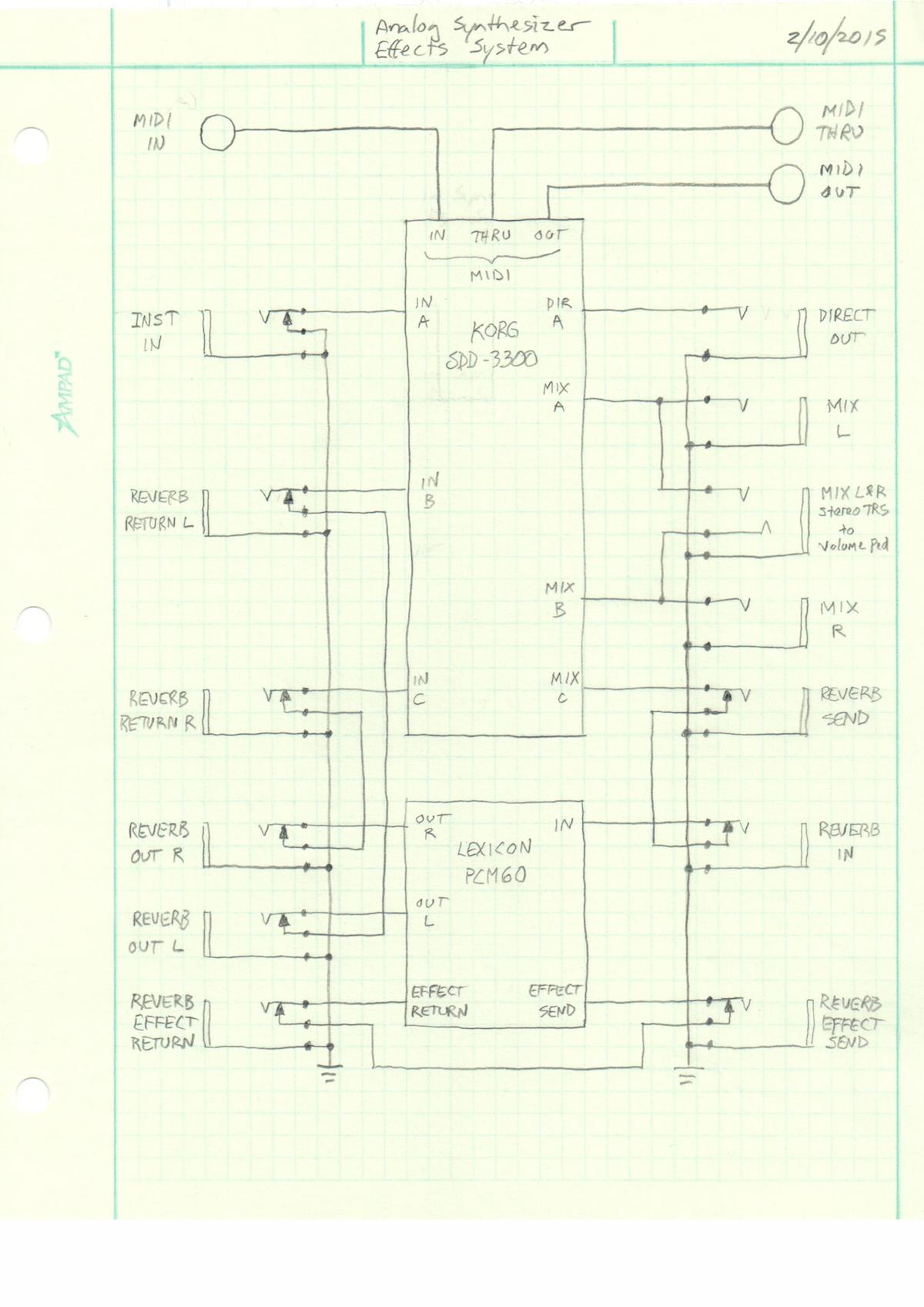
using the leftover I/O on the SDD-3300 to
integrate them. So I routed the third 3300 output to the mono
input of the PCM60, then routed the stereo PCM60 outputs to the two
unused inputs on the 3300. With this combination I found a
more
flexible effects system, and since the inputs and outputs of the
3300
can be programmed I could program the reverb levels of the PCM60!
I have gotten some very good effects with this combination - so good
that I decided this was going to be a dedicated effect system per
synthesizer, rather than a master effect. The assembly and
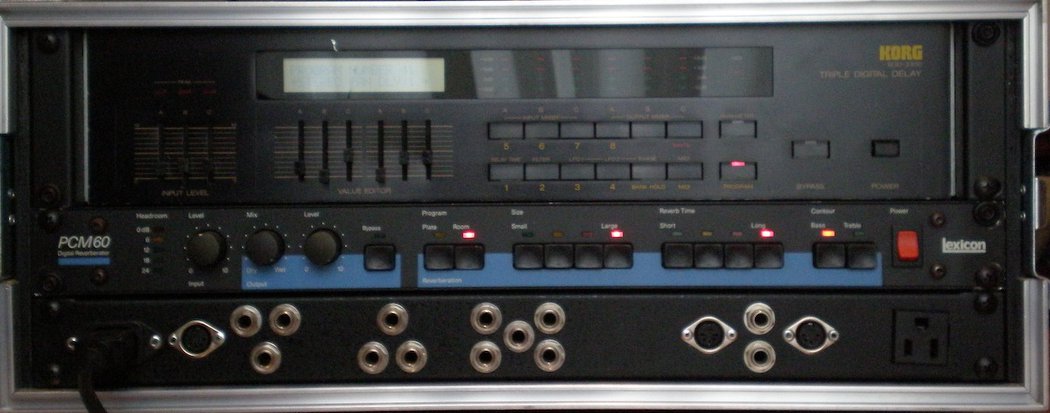
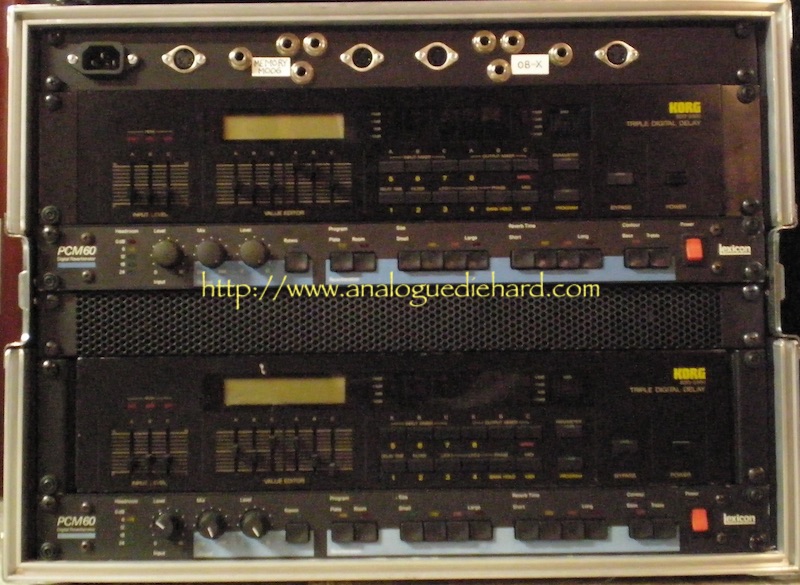
diagram in the 1st column of the table at top shows how I put it
together. I built single sets in a rack for the studio
instruments - one for my Memorymoog,
one
for my OB-X, one
for my
OB-SX.
I routed
the stereo outputs to Ernie Ball 25K stereo
volume pedals, using 1/4" TRS interconnect for L/R connections on a
single cable to minimize cabling (a convention I established while
designing my off-site system). The stereo volume pedals are
balancing volumes of the studio synths while experimenting - and
none
of the MIDI retrofits for the old Oberheims implement MIDI volume
control.
For the stage system I built three
more, one dedicated to the Moog Voyager and two dedicated to
independent polysynth outputs (the assembly in the 2nd column in the
table at top). The previous incarnation of the stage system
used
my Alesis
Andromeda's
AUX outputs for routing to these effects, which
proved so useful that I am currently configuring a desktop module OB-X8
to duplicate the AUX routings using the separate L/R outputs on the
OB-X8. The Andromeda is showing its age so I am retiring it
from
the stage (hey I'm a poet and I didn't know it!).
I can
put the delays and reverb in series in any order or in parallel, and
I
actually process the PCM60 reverb tails using the 3300 to get better
stereo reverb effects that sounds like the Lexicon bigger
brothers. The bonus is it doesn’t alter the tone of the
original
signal one iota. I am very glad I chose the option of
separate 3300/PCM60 set for each synthesizer. One benefit of
the
dual polysynth set for stage use is I can configure one PCM-60 for
room
reverb and the other for plate reverb, and simply configure routing
of the patch to the desired reverb. The 3300 includes a bonus
as
it can map effect
patches to received MIDI program numbers, so when sharing the same
MIDI
channel
of the synthesizer I can map a specific effect to a synthesizer
patch
number. That conserves MIDI channels. Surprisingly, MIDI
program mapping is a feature seldom found on effects processors or
synthesizers, yet it is a very practical tool.
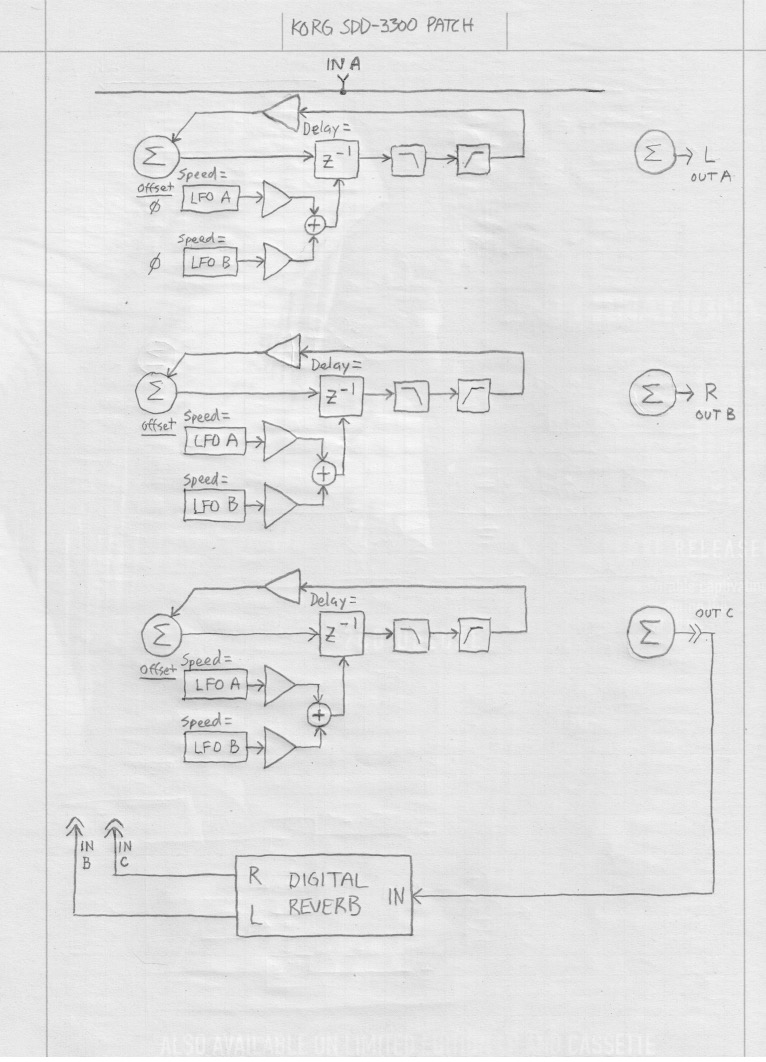
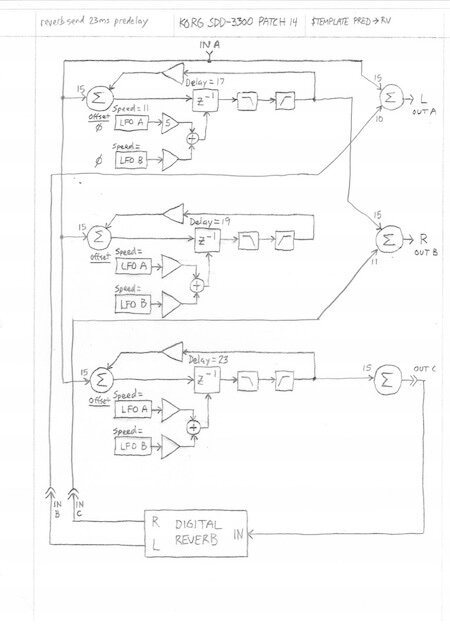
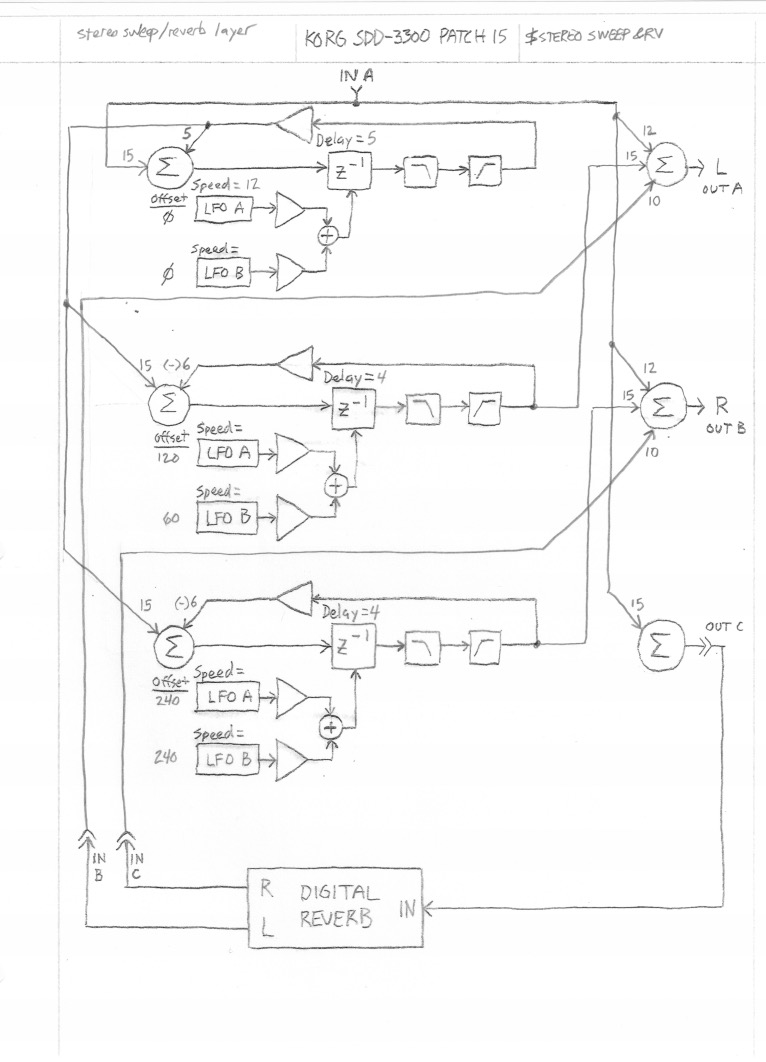
For patch archiving,(yes I keep paper backups in addition to MIDI
sysex
backups), I drew up a blank patchsheet for visual analysis of
patches -
the digital reverb is just a sole abstract box (you're free to use
any
digital reverb), while the rest of the patchsheet is the 3300.
I
like these block diagram patchsheets with engineering symbols much
better than the "patch table" in the 3300 user's manual. Using
that blank template, I drew up my patches. In the 2nd table at
top I have supplied the blank patchsheet, plus some sample patches I
built. If you study the patches you can get a visual idea how
an
effect is configured.

Home