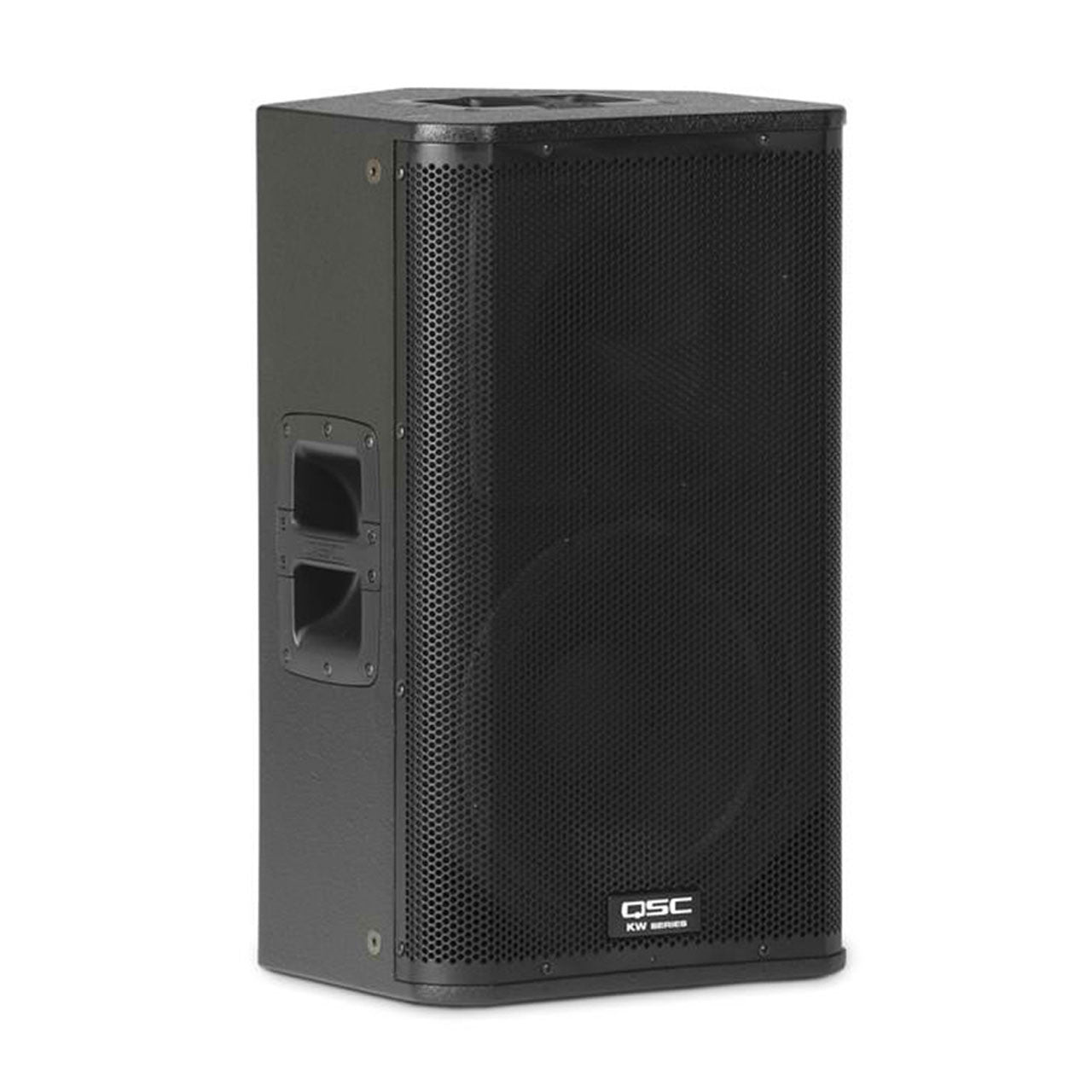
QSC KW122 Active Powered Two Way Monitor
Last Update 02-08-2026
During 2021, I made a major relocation to a new job/new state and I met
up with a school musician friend who had actively gigged there for
years. When I was discussing whether to bring my large PA with me, I
was told I would not need it as it will be too big for almost every
venue. He was right. In addition to that, I would not
have had storage space for cabinets that big in the house I bought
when I relocated. In due time I was playing in his band and
using my old reliable Bose 802 as
my keyboard monitor. But some of the venues in the new town
have stages that were just too small for the Bose and
amplifier. My buddy uses the newer active powered monitors and
he let me try one at a gig for keyboard monitor. The idea of
an active powered speaker sold me, so after some research I acquired
the self powered QSC KW122.
I selected the KW122 because I wanted an enclosure constructed from
birch plywood. I had heard some monitors with polymer
enclosures and was not impressed with the fidelity. I had
enough experience with sound reinforcement to know that polymer
enclosures are not uniformly stiff all along their walls, and those
weak spots create resonance problems that muck up the frequency
response. Birch plywood cabinets are well known in the
industry for best sound reproduction, and the wood construction is
very strong. The KW122 is constructed of 15mm birch plywood
with a tough black textured painted finish. Birch cabinets are
more expensive but you get what you pay for. Cast recessed
aluminum integrated handles - one on top, two on sides - make easy
lifting for this 50lb box. A cover was included when purchased
new.
The other reason for the KW122 the omission of an LCD display - this
was intentional. LCD displays are very common on synthesizers
starting in the 1980s, and they are a common failure point.
Depending on the display, there may or may not be a direct
replacement in the future. I had seen used active speakers in
music stores with the tag "malfunctioning display" which told me a
lot. Rough handling of heavy speakers is not kind on delicate
LCD displays. For the KW122, all the processing you will need
are on mechanical switches on the rear panel of the power module.
These KW models are third generation QSC designs that are mature, so
the performance is optimal and improved over earlier models.
This multipurpose model is a near field 131dB SPL monitor with
narrow 75 degree dispersion. While 131dB SPL sounds like high
volume, the reality of a "near field" speaker is that the volume
drops quickly about 5-7 feet away from the drivers - they do not
project over long distances. This is actually intentional for
monitor applications. It might suffice for a vocal speaker in
a coffee house, but not for a speaker in a full range PA system in
any bigger room. The two way speaker drivers are a 12in and
1.75in high frequency diaphragm compression driver giving a
frequency range of 53hz to 18Khz with 6dB deviation. To my
ears the frequency response sounds pretty level. The speaker
can be suspended with integrated M10 points, mounted on a speaker
pole via an integrated 35mm dual angle pole socket (including a
7.5deg tilt), or placed as a floor stage monitor. The 16 gauge
steel speaker grille is rugged protection of the drivers.
The integrated 1000 watt power module (dual 500w amplifiers for the
LF driver and HF driver) is the modern class D design which is very
efficient, lightweight, and produces little heat. It includes
protection of excessive speaker excursion and a fan that is
temperature activated. Hookup is easy - just audio cables and
the IEC locking power cable (which doesn't inadvertently slip out of
the AC inlet). Line voltage is auto-sensing. Status LEDs
are provided for standby (green), limiting (red), and power
(blue). An LED on the front of the speaker can be configured
to duplicate any one of the three status LEDs. Limiting is
active in the presence of high signal level at any frequency or if
the amplifier gets too hot. If the amplifier goes into
limiting with both GAIN controls at minimum after ten minutes, this
is an indication of a malfunction. Multiple KW122 cabinets can
be remotely controlled via the REMOTE GAIN connector using a passive
relay or potentiometer, or an active source.
The processor section of the power module is simple but
sufficient. A DSP provides protection features for the drivers
and EQ options. The three position "LF" switch offers normal,
deep, and 100hz high pass (IE ext sub) responses. The deep
position produces extra low frequency output. The 100hz high
pass is set when used with a subwoofer, or is recommended when the
cabinet is utilized as a floor stage monitor for vocals (prevents
muddy sound from excess bass build up on the stage). The two
position "HF" switch offers flat full range response or "vocal
boost" which produces a stronger presence for better speech
recognition.
The mixer section is equally rudimentary but practical. There
are three audio inputs - A channel, B channel, and stereo RCA summed
to mono. A and B channel inputs are the "combo" type that
accept XLR or 1/4in plugs, balanced or unbalanced. The B
channel is line level only, while the A channel is mic or line
level. A four position MIC GAIN switch sets the A channel gain
between 0db/12dB/24dB/36dB, and a yellow LED indicates presence of
mic signal. Both channels have XLR discrete outputs (for
chaining other monitors or as a feed to FOH) and green LEDs to
indicate presence of signal before the GAIN controls. Both A
and B channels have GAIN controls from OFF to (+)10dB which are
summed to the LINE OUT jack and the power amplifier. Having
two channels is great for a single KW122 serving dual roles as a
keyboard monitor (B channel) and vocal monitor (A channel).
The GAIN settings are great for balancing keyboard level to vocal
level in the monitor.
While class D amplifiers are very efficient, they are a complicated
design that is near impossible to repair. The usual repair
route is to replace the entire power module, and since the KW122 is
now discontinued these modules are no longer available.
As a stage monitor, the KW122 has been very practical as it serves a
dual purpose as keyboard and vocal monitor, which I can balance
without accessing the FOH mixer. I have high fidelity demands
with my keyboard work and the KW122 delivers. They have found
another use in my studio as a monitor for my MIDI drum kit; some
time later I acquired a 2nd KW122 that was a "restock" item, a
returned item literally brand new and re-sold with a slight
discount. The studio monitors were not loud enough with the
drum kit so the KW122 solved that problem. It can also serve
as a monitor in the "guitar room", which plays back the song while
the guitar player is jamming away. I keep one KW122 in the van
ready for gigs, while the 2nd one stays in the studio but is
reserved for gigging duty.

Home