Moog Minitaur Analog Bass Synthesizer MIDI Module
Update 02-02-2026
In 2010, Moog Music built a faithful reissue of the famous Moog Taurus I with their Taurus III to great fanfare.
It does one thing, and does it well... BASS. While the production of 1500 T3 units had sold
out in about a year, customers were asking for a less expensive
compact tabletop MIDI version without the pedal clavier and large
case. Moog responded with the Minitaur in 2012, and to date they are
still being made. That's a testament to the popularity of the
module.
I hadn't considered one until I joined a 70s/80s band; they had seen
my website and were very enthusiastic about me using my Taurus
pedals with the band. I was also in the process of designing my stage
rig that is heavily populated with rackmount devices, so I
decided the Minitaur was a good addition to have it prewired in the
rack and keep the cartage to a minimum. For that purpose I ordered
the optional rack ears. Wood end pieces are also available.
I needed MIDI input, USB input, and audio output brought out to the
front for convenience. With the Minitaur racked, I did not want to
burrow through the rat's nest of cabling with a flashlight from the
back of the rack. I built I/O panels for the rack but no space was
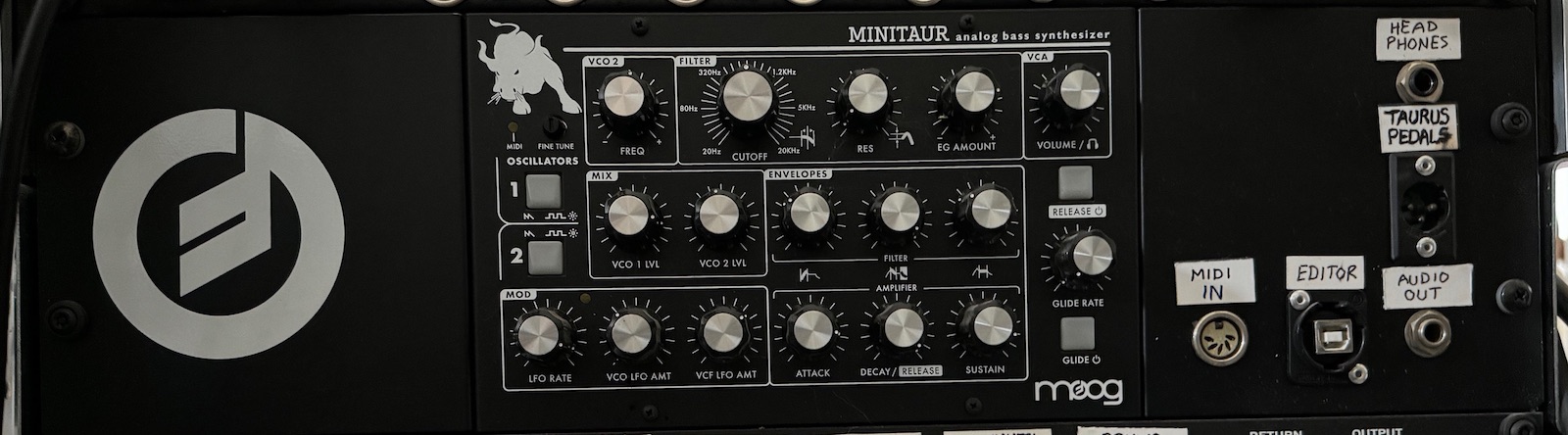
available on them for more jacks, so I used one of the Minitaur rack
ears for an I/O panel. Later I added jacks for headphones and an XLR
output for the Radial
JDI DI box to the FOH. Now I can plug in the laptop editor
over USB without monkeying in the back of the rack. One problem with
the rear panel of the tabletop format is that an extra 1U above is
needed for clearance of the plugs. I got around this two ways 1)
used right angle plugs 2) positioned the Minitaur right below an I/O
panel with chassis jacks but no enclosure. Some straight plugs
protrude above the module, not a problem as they cleared some gaps
in the I/O panel above it. I just left the shell off the MIDI plug,
since MIDI is a current loop it isn't vulnerable to EMI so the
shielded plug was not vital.
My Moog Taurus II Controller
was retrofitted with a MIDI interface so I could play the Minitaur
over MIDI from my feet. The Minitaur is powered from a "wallwart"
adapter, and I will not use wallwarts for gigging. So I enlisted my
rackmount Juice Goose 12PAQ
to supply the power, which eliminated the wallwart.
top
The Minitaur adds features above the Taurus
feature set. It can respond to MIDI commands over MIDI DIN; the USB
port can receive/transmit data for the editor software and/or echo
MIDI commands received at the DIN port. There is no MIDI out or thru
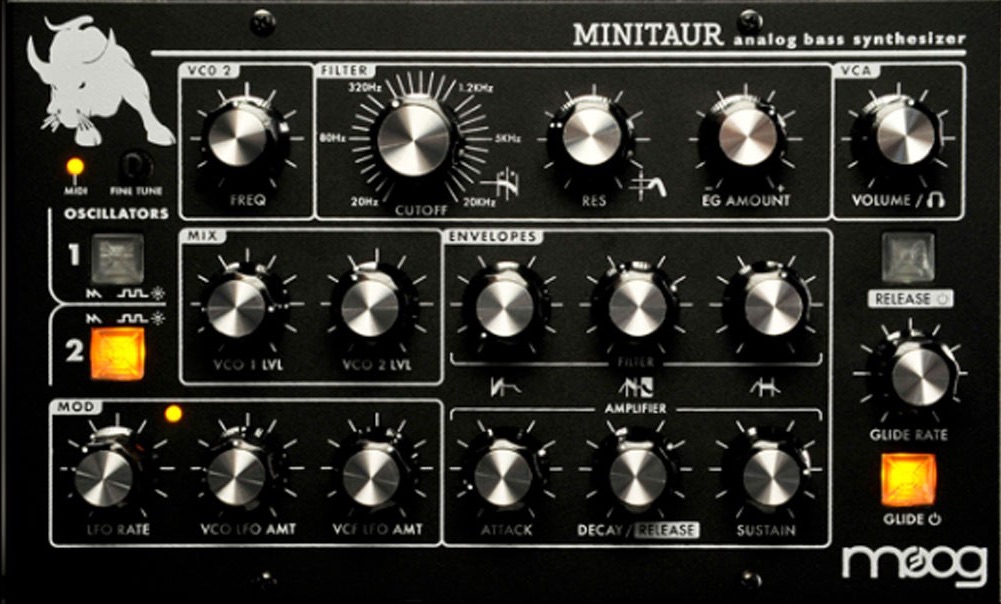
port. On the front panel, Moog added square waveshapes for both VCOs
(sadly not variable pulse - so close...), LFO with routing
to either/both VCOs and/or VCF. The EG are the traditional ADSR,
rather than the period correct but oddball ASR (VCA)/ADS (VCF)
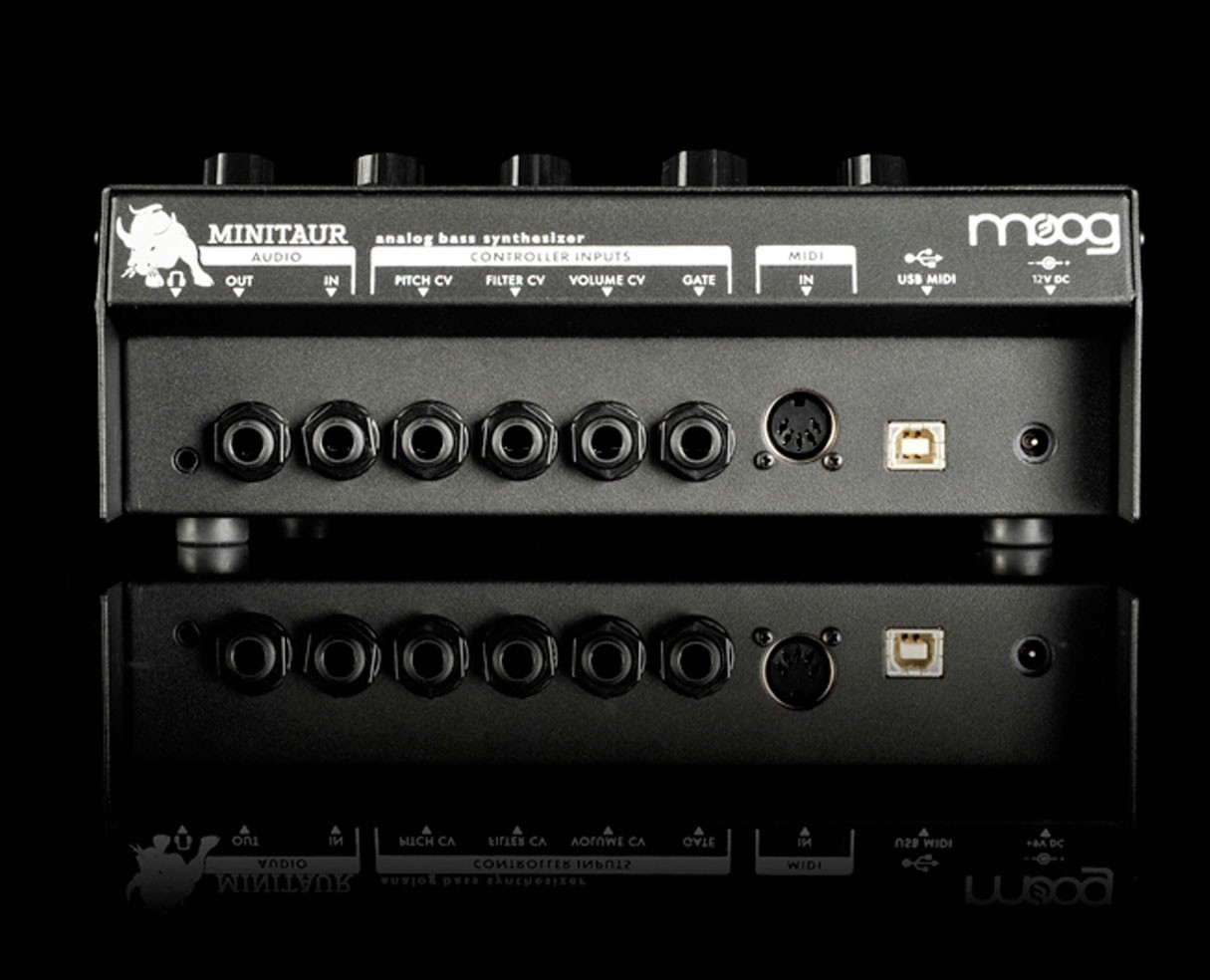
configuration of the floor pedal units. Rear panel CV inputs allow
you to use CV pedals or other CV controllers for filter, pitch, and
volume. There's also an input for gate, so the Minitaur is ready for
your external sequencer of CV keyboard controller. There's also an
audio input to the filter.
But under the hood are more features accessible with either the
Minitaur editor or via MIDI messages. Sadly the Minitaur editor is
now abandonware - the last released version was 3.3.2 and may not
run on macOS versions above Catalina (10.15). I have no idea if the
editor works with current versions of Windows. I have included MIDI
commands here (right click to
download). Some of the "under the hood" features can be changed with
button/knob combinations (refer to the user manual). One problem
frequently encountered with the editor is failure to connect with
the Minitaur - I found that the editor only works on one certain USB
port, so try different ports until you find one that works.
The image at top left shows the main interface of the editor and the
extended features "under the hood":
- The oscillators add hard sync and note sync - the latter
resets the VCO waveshape cycle with each new MIDI note on
command
- VCO2 adds beat frequency (different than detune, it scales the
"beating" of detuned VCOs as the notes progress up and down)
- Glide can be legato triggered and slopes can be exponential
(default in the Taurus I), LCR (linear constant rate, similar to
Minimoog), and LCT (linear constant time)
- VCF adds variable keyboard tracking (fixed at 50% on original)
and velocity sensing (a way cool effect with resonance)
- EG can be configured as shared D/R (linked) or separate
(independent) for the full ADSR action
- Trigger modes for the EGs can be legato on (IE single
trigger), legato off (multiple trigger), or reset (looping while
triggered, for use as a modulation source)
- LFO waveshapes can be triangle, square, rising ramp, falling
ramp, S&H, or VCF EG which can be routed to VCO 2 only -
great hard sync trick of the Moog Rogue
- LFO can be sync'd to MIDI with clock divider and the waveshape
cycle can be reset with each new MIDI note on command
- MIDI velocity sensing can be applied to the VCA
- Key priority can be low note (default on original), high note,
or last note
- While the Minitaur does not include a pitch bend wheel, it
will respond to MIDI pitch bend and the range of bend is
adjustable for both bend up and bend down
This cheat
sheet shows the button/knob combinations for accessing the
extended features from the front panel.
The image at middle left shows the setup panel for other settings
for the Minitaur.
The Minitaur is fully programmable with storage for 128 user patches
that can be recalled over MIDI or USB. Some front panel buttons
double as preset up/down select, although there's no display showing
the present preset (hey, customers requested low cost!). The editor
also includes a preset manager to organize your patches and
save/recall them on your laptop. The editor is the only tool that
can archive your patches.
So does the Minitaur duplicate the deep
rich low end roar of Taurus I pedals? Oh yes they do - they possess
that elusive oomphTM
that has defied emulations for decades. The sound of the famous
"Taurus" preset opens with a throaty growl, then settles to a
pleasant distinctive purr as the filter cutoff decays. The filter
setting and EG decay was easy to emulate on my other analog synths,
but that purr and/or growl wasn't quite the same. Moog also
succeeded tonewise with their Taurus III.
The FOH engineer for the 70s/80s band used to tour nationally and
was very good at mixing - and he welcomed keyboards unlike some FOH
people I have encountered. He especially welcomed bass. He built
very good subwoofers for his PA, each constructed of 3/4in thick 13
ply birch plywood and loaded with two 18 inch speakers. When he
learned I was using the Taurus pedals, he reserved a channel for
them separate from my keyboards (that's why I have the DI output).
Those subwoofers really breathed fire with the deep low end of
Taurus pedals - you didn't just hear them you FELT them. There were
a couple of venues where the place shook when the Minitaur were
played. One occasion we were doing sound check - the FOH engineer
had his frequency analyzer set up, and he said when I played the low
C note on the Minitaur the analyzer registered all the way down to
20hz. And this was an outdoor show! Not many subwoofers reproduced
down as far as 20hz, which is a testament to the FOH engineers
skills at cabinet construction!
top
Many owners have been disappointed at the
limited six octave note range of the Minitaur. While it is excellent
at low pitches, it doesn't go high enough for lead sounds. This is
also a limit shared by the Taurus I and Taurus III, and is due to
circuitry. Moog went to great lengths to replicate the original
Taurus pedals; the oscillators were V/hz in contrast to the more
common V/oct with the higher range that players expect. V/hz is
cheaper to build, lent itself easily to the one octave pedal
clavier, and lack of LFO/pitch bend (in the original) did not
require v/oct. But V/hz synthesizers have a smaller pitch range
because the control voltage doubles for every octave and you
quickly reach the power supply voltage - you can't go any higher
than that. That's why it has an upper limit.
There's also an inherent limitation of opamp technology that limits
how low the pitch control voltage can go. For every descending
octave, the voltage halves. An opamp is mandatory to sum the pitch
control voltages. Assuming maximum power supply voltage of 12VDC and
a design top pitch at a control voltage of 12V, each descending
octave goes 12V, 6V, 3V, 1.5V, 0.75V, 0.375V... uh oh. As the
control voltage descends in lower voltages you are creeping into the
error domain of opamps. Offset error is a necessary evil of opamps
and cannot be avoided. The lower you push the V/hz oscillators, the
worse the tuning - and it only takes a few tenths of a millivolt of
error in the lower ranges to throw off the pitch. And the tuning
errors will be different between VCOs. That is why V/hz oscillators
have a limited range of useable frequencies.
The limited edition Sirin is the same box and circuitry except the
frequency range was shifted up for non-bass duties. It does not
extend down to low bass frequencies though.
top
The Minitaur has found a home in many MIDI
studios and performing rigs. To my ears they have a slighty deeper
low end than the T1 and T3. There are plenty of tabletop analog
synths with the same basic feature set, but there are subtle circuit
designs in the Taurus models (except the weak Taurus II) that gave
the Taurus voice its reputation for solid low end and distinctive
growl.
A study of the circuit board reveals a LOT of components, all in SMD
technology. Now, don't panic over concerns that SMD components don't
sound like the original that used through hole components (THT) -
with correct design techniques and component substitutions they can
sound big and fat. The world is moving away from THT components
which are getting harder to find. The Moog Voyager was
discontinued because the analog circuit board is 100% THT and would
had required a major redesign to upgrade to SMD. Rather than
redesign the Voyager, Moog chose new models with advanced circuits
using SMD.
There is a 3rd
party overlay for the front panel (top middle image) that
illustrates the button/knob combinations for extended features so
that you don't have to refer to the user manual all the time. The
overlay also fits the Sirin, but must be held in placed with
adhesive; the overlay was designed to magnetically adhere to the
ferrous metal panel of the Minitaur, but the panel of the Sirin is
aluminum which is not ferrous.
My Moog Source - although
not quite the oomphTM
of a Taurus synth - is a very good bass synthesizer in my studio; I
had long wished for a rackmount version for gigging. I hadn't found
a rack device that had its beefy girth and excellent filter
sonority, until the Minitaur. The Minitaur comes damn close
- the only missing features are triangle and variable pulse
waveshapes for the VCOs. But the Minitaur is close enough, as its
filter has a wonderful resonant quality that can produce timbres
other than bass sounds and it has useable features beyond those on
the Source.
With the Minitaur firmly planted in my stage system, I have
relegated the Taurus pedal units to my studio. I no longer have to
extract the pedals from the studio for gigs.
top

Home