Moog Taurus I Bass Pedal Synthesizer
Update 06-14-2014
The Moog Taurus I is a self-contained synthesizer famed for its
earthquake-inducing bass timbres. It does one thing, and does
it well... BASS. It
was originally designed as one of a trio of synths for the Moog
Constellation system, which consisted of the Lyra (a monosynth that
never made production), the Apollo (the Polymoog prototype), and the
bass pedal synth which became the Taurus. The Lyra and Apollo
currently exist in the Audities collection in Calgary Alberta Canada
but the prototype bass pedal synth is long gone. Like the
Minimoog, the Taurus stands as the standard against which all other
bass pedals are measured.
I had wanted a clean set of Taurus pedals for a long time.
Most of the ones that show up on auction sites or in stores had been
well gigged, were ratty, or needed repair. The market value
for Taurus pedals was $2,000 and climbing - higher than a vintage
Minimoog. Pretty absurd prices for a synth that does little
other than bass sounds. I was checking out one of my regular
jaunts, a vintage guitar store that sells vintage Fenders, Gibsons,
and PRS guitars. On occasion they have a synth or combo organ.
They had an excellent condition Moog Liberation a few years prior
with a fairly high price tag, it took them over a year to sell
it. This store had also sold vintage accordians, and I spotted
an oversize accordian case in an inconspicuous place.
My curiousity was aroused. "That's an awful big accordian".
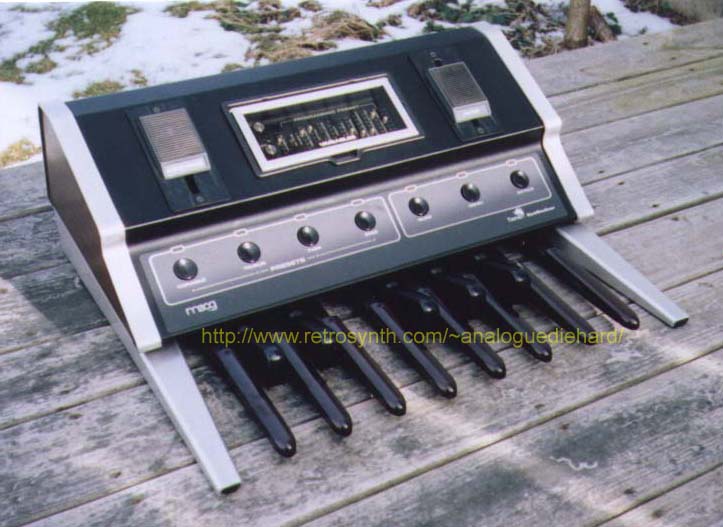
Popped the case open and inside was a pristine set of Taurus pedals. They weren't even on display!
Spotless case, no broken pedal keys, missing the window/bezzle over
the controls. On the handle was a price tag. On
disbelief I took the case to the counter to confirm the price.
The price they were asking was less than half the market
value! They had belonged to an employee of the store.
After doing a quick run-over of the pedals, I immediately bought
them. This was a lucky find, as this was a reputable store that
sells vintage guitars and has net connections so they can check
auction sites and other stores for current values. You would
think that after selling a 1959 sunburst Les Paul Standard at market
value (yes they have had them in that store) that they would know
the value of Moog Taurus pedals...!
The case was a factory polymer molded case with stiff foam supports
inside. A peek at the old Moog Music price lists shows that
the case was offered only for a couple of years, last in 1976.
The inspection tag inside the pedals dates it to 1976, a year after
they were introduced. The pedals were so clean that I don't
think they have ever seen a stage. I called around and Mike Bucki had
NOS bezzles and could make the window assembly. I got them in
a couple of weeks and the window looks like the original, even the
VARIABLES label looked authentic. I only had to add magnets so
that the window would stay closed when I moved them. Many
Taurus pedals are missing the window/bezzle because they were
friction fit to the case and they often worked loose. I had to
secure them from the inside using RTV, worked like a charm.
According to Bob Moog, the Taurus I pedals were designed not by Bob
but by Dave Luce, who also designed the Polymoog. Dave copied
the Taurus filter from the 904A low pass filter module of the Moog
modular systems. Dave Luce's name appears on the three US
Patents for the Taurus pedals (further reading on Don
Tillman's site).
The 13 note Taurus has three preset sounds, plus a fourth "variable"
which is a user configured sound using the controls in the middle of
the panel. Encompassing the control panel are a pair of foot
controlled slidepots, one for volume, the other for filter
cutoff. These work for all the sounds and are useful for
varying the presets. Above the pedalboard are footswitches -
four for the presets, then glide, decay (release actually), and
octave. The presets are labeled "Bass", "Tuba", and
"Taurus". "Bass" is a dual VCO synth bass sound with a
rapid decay transient that begs to be sequenced or be played by
hand. "Tuba"
is a single VCO sound that has better use when processed, IE stereo
chorus. That single VCO is one solid bass sound though.
"Taurus"
is the famed sound favored by prog rock groups like Genesis, Yes,
Asia, UK, and Rush as well as Motley Crue and The Police (Andy
Summers had a set, Sting had a pair in front of him).
The control panel defines the "variable" sound - you are given
control over footage from lo-mid-hi (shared with both VCOs), VCO A/B
mix, VCO B frequency (little over an octave), VCA Attack/Decay
(actually Release), VCF Attack/Decay, VCF Cutoff, Emphasis, and
Contour Amount. These controls do not affect the presets, they
are set by fixed resistors. Three other controls - Glide,
Beat, and Tune - work on all the presets. Beat is like a
master detune control for the VCOs. The VCOs are rising ramp
waveforms only - they are not falling ramp as illustrated in the
Taurus user/service manual. There is a SUSTAIN LEVEL control
grouped with the VCA Attack/Decay but it is not the traditional
SUSTAIN parameter associated with the industry standard ADSR
EGs. It is actually a volume control for the "variables"
preset, similar to the contour amount for filters. The VCA EG
is A/R with full sustain, the VCF EG is A/D with zero sustain.
Bass is the Taurus pedals' forte. Below are samples of some sounds
under the "variable" palette. These are best heard/felt with
subwoofers or headphones, you won't hear that deep bass with generic
PC speakers. None of these sounds have any processing or EQ.
Shoes make a difference playing the Taurus pedals. Hard flat
soles work the best, long accepted by organ players in churches and
theaters. Sneakers don't work as well, particularly when using
the footswitches. There is too much "sponge" in soft sole
shoes and you don't get the firm playing tactile response you do
with hard soled shoes.
I own other Moog keyboards - Memorymoog, Minimoog, Source, Polymoog,
Liberation, Voyager. The Source was my primary bass keyboard
since 1985. They could hold their own against the Taurus, but
the Taurus has that indefinable oomphTM
that separates it from the rest. It is true that the Source
can emulate the Taurus pedals as I have copied the sound, but
something was still missing. The sound of the famous "Taurus"
preset opens with a throaty growl, then settles to a pleasant
distinctive purr as the filter cutoff decays. The growl and
filter decay was easy to emulate on the Source, but that purr wasn't
quite the same.
The "Tuba" preset demonstrates how massive and solid just one Taurus
VCO can sound. None of my other Moogs sound this big. I
use Rane line mixers with no EQ so there is no question of EQ
differences. I could get the growl and filter decay of the
"Taurus" preset on the Source but it didn't have the mass of the
Taurus VCO. What was missing?
There is a myth that the Taurus is fatter because of the linear v/hz
VCOs. An exponential VCO, used in Minimoogs and just about
every other synth, contains a linear voltage to exponential current
converter followed by a ramp generator based around a charged cap
with reset pulse. A study of the Taurus VCO reveals the same
circuit minus the exponential converter - giving it a linear v/hz
response yet with no difference in the audio sonority in the ramp
generator. My first gigging synth was a PAiA 4700 modular with
linear v/hz VCOs and these were far from the obesity of a Taurus
VCO.
So why do Taurus pedals sound so big? One answer is the
coupling between the VCF and the VCA. The service manual
states that the AC coupling between the VCF and VCA was designed so
that the RC product would increase the bass at a corner frequency of
20hz. There is a bass boost built into the Taurus
pedals! According to Bob Moog, Dave Luce simply lifted the
filter design right out of the modular - the 904A low pass filter
module is one mighty big sounding filter so there is no question
about that.
The other element of the bigness of Taurus I pedals is distortion in
the waveshape. This is due to two factors 1) the filter is
driven pretty hard which introduces harmonics 2) the filter feedback
recovery amp and the VCA are CA3080 OTAs which are NOT high fidelity devices, they
actually introduce subtle distortion. This changes the timbre
to the point that the fundamental is emphasized. This also
introduces a compression effect via overdriving the filter.
This is also why Taurus I pedals do not suffer from phase
cancellation of dual detuned VCOs as the timbre animation cycles
around.
So that "bass boost" is the "purr" that is missing from the
Source. Therefore the Taurus bass sound remains unique.
Many analog synths need a 10-20 minute "warm-up" period for the VCOs
to come in tune - the reason is that the expo converter has a
temperature factor that affects its conversion. When power is
applied the components heat up over time, settling at an operating
temperature higher than ambient temperature. During this
"heating period" the expo converter will be inaccurate, which means
the VCOs will not be in tune. Once operating temperature is
reached, the VCOs are in tune. Because the Taurus is lacking
the expo converter in its linear v/hz VCOs, there is no warmup time
needed to wait for the VCOs to tune - they are ready to play when
you turn them on.
Why do the Taurus use linear v/hz VCOs? One, it is a one
octave pedalboard therefore octave switching is trivial. Two,
no modulation of any kind (pitch bend, mod wheel) is needed for a
bass synth.
The "Taurus" preset doesn't suffer from phase cancellation of dual
detuned VCOs, which led to the myth that the Taurus pedals contain
some kind of compression - not true, say the schematics. What
the schematics DO reveal is that the mix level of the VCOs are not equal on the "taurus"
preset - if you turn down the level of one of the VCOs, the phase
cancellation is minimized while you can still hear the timbre
animation. This is a trick I have been using on the Source
since I bought it back in 1985.
You haven't heard justice done to Taurus pedals until you play them
through a proper PA system. I have a two way PA system
consisting of a pair of JBL SF25s (2x15 plus titanium tweeter) and
two pairs of EV S-181 subs with 18" speakers. This is a big
sounding system, hall-caliber quality. Those subs got a
workout with the Taurus pedals, they have some serious BOOM that you
won't hear on small studio speakers. I never felt such
subsonics in my life. Now I know what a Genesis or Rush
concert experience would have felt like (I never caught either in
concert).
The Taurus I pedals were in production from 1974 to 1981. From 1982 to
1985 a second version called the Taurus II was released which is an
18 note pedalboard with the synth "brain" module suspended at
playing height via a pole. The electronics of the Taurus II is
identical to the compact Rogue synthesizer with the exception of the
keyboard CV circuit. While this model has more features, it is
a pale imitation to its predecessor. It does not have the big
bass sound of the original Taurus I. There was also rumor of a
Taurus III. No such device by that name was ever made, it is
likely confused with the Taurus Controller which is the Taurus II
pedalboard minus the synth "brain" module - it has trigger and CV
outputs, but no synthesizer circuits inside.
The achilles heel of Taurus I pedals are the pedal key
contacts. They are exposed to the floor and the elements which
leaves them vulnerable to collecting dust and debris. The
contacts are also silver plated which can tarnish and render a key
to malfunction. If a range of keys from high C below stops
working, it is dirty contacts. The best way to clean them is
to remove the circuit board containing the contacts and apply Tarn-X
tarnish remover with a pipe cleaner. Any tarnish remover will
work but Tarn-X is a strong cleaner. WARNING - use Tarn-X in a ventilated
area, the fumes are mighty noxious!
If
you tire of cleaning dirty key contacts once a year, Kevin
Lightner makes a replacement key contact PC board that uses
high reliability leaf switches in place of the silver plated spring
contacts. This is a complete circuit board which is a direct
drop in replacement. I bought a set and have been very happy
with them.
Another foible of Taurus I pedals is failing frequency divider
trimpots. These do not age well and will cause the pedals to
go out of tune when you move them. The service manual has a
procedure for replacing them with standard trimpots and
resistors. The lubricant in the slidepots can dry out and make
them sticky. Mike Bucki tells me that petroleum jelly can be
used to re-lube them but I would recommend Dow Corning 7 lubricant
as anything containing petroleum distillates or byproducts will
damage the bushings making them swell up. I also question
whether a petroleum-based lubricant would have a corrosive effect on
the resistive element of the slidepot.
The pedal keycaps can break. The best way to prevent that is
to use the Taurus on a rug or a small remnant. Lowrey and Moog
were both owned by Norlin back in the 70s so Lowrey supplied the
pedalsets used in the Taurus. If you need keycaps they can be
scavenged from Lowrey home organs, however the keycaps on the
current Lowrey organs are not the same.
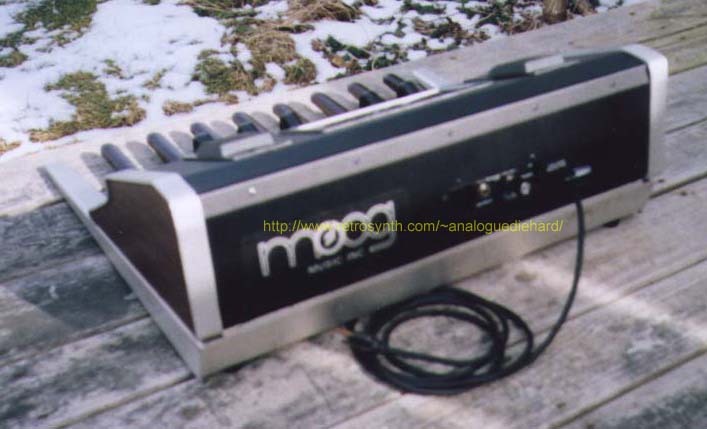
There is a great big cap plug on the rear panel of the Taurus I
pedals. This was supposed to be a connector to an external
accessory box that allowed external control of the "variables"
controls. There were connectors on the Taurus circuit board
ready for this accessory, which according to the user manual was
available from the Custom Engineering department of the original
Moog Music. Mike Bucki worked in the Custom Engineering
department and he has never seen this accessory box, ever.
David Kean of Audities tells me that Dave Luce had planned this
interface to work with the Polymoog (carrying some design proposals
from the original Moog Constellation), but that feature never came
to fruition - too many engineering changes to the Polymoog prevented
any development on it.
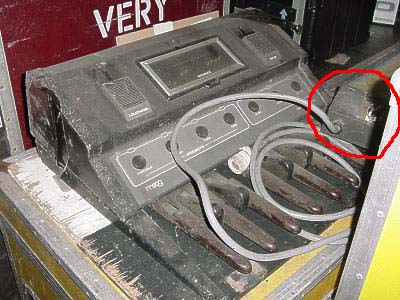
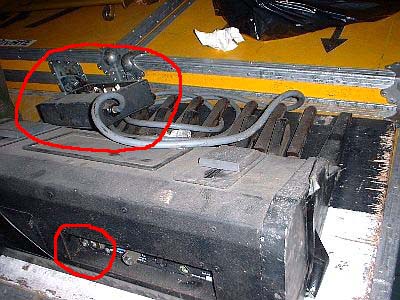
Although Mike Bucki has never seen the accessory box, I spotted a web site that
had pics of a set of well-worn Taurus pedals belonging to
Genesis. There is a box laying on the pedals (highlighted in
pics below) with a circular multipin connector at its cable
end. The box appears to contain slidepots of similar model and
layout of the Taurus control panel, and the cap plug on the rear
panel is replaced with what appears to be a mating connector.
This may a very rare example (maybe the only one) of the optional
accessory box for the Taurus Pedal.
Adding MIDI I/O to a Taurus I is not trivial as there are no
interface I/O jacks. Kenton used to offer a decent MIDI
interface that is long out of production. You need a CV
converter that generates a v/hz CV signal, not the more common
v/oct. You'll have to drill some holes for jacks. There
are a few companies that offer suitable converters. I'm not
happy with the current solutions - the aforementioned Kenton Taurus
MIDI kit was the best solution. It avoids calibration issues
with CV trimming, includes a MIDI out that the others do not, and
activates the footswitches in response to MIDI controls. Since
I want to add MIDI to my Taurus pedals, I am planning a homebrew
MIDI interface patterned after the Kenton solution using a PIC
controller. Since the Taurus circuit board was ready to accept
an external accessory box, I may attempt to access those points
using MIDI CCs converted to CV control.
Can the Taurus I pedals be cloned? The circuit uses standard
parts, but the keyboard circuit used a custom integrated resistor
array that is no longer available and the CA3080 OTA is becoming a
member of the endangered species list. The Taurus I case
itself would be expensive to reproduce and a pedal set would not be
cheap. A faithful reproduction of the Taurus I pedals would
have to be an accurate clone of the voice circuits as the sound is
critical. One could clone the Taurus I synthesizer circuit in
a tabletop or module form and use an aftermarket MIDI pedalboard to
get the same function (less the footswitches), and it would cost
less than a faithful reproduction.
Fortunately, Moog
Music has reissued the Taurus pedals in the form of Taurus 3, which is a
faithful reproduction of the Taurus voice with added bells like MIDI
and programmability. A limited run of 1000 units proved so
popular that they built past that - serial numbers are approaching
1500. Moog has just announced the Minitaur
which is a tabletop synth with the Taurus voice but with some
features stripped to make it more affordable.
Why is there a big appeal for the Taurus I pedals? Why do
people pay over $3,000 for a used set, even ones that are
broken? Why do vintage synth dealers have a waiting list of
customers wanting Taurus I pedals? One attribute is the sound
- they possess the beefiest most solid bass sounds I've ever
heard. One user claims to have witnessed chairs moving on the
hall floor when he was testing his Taurus pedals at a
soundcheck. Another memorable auction description describes
the Taurus pedals as "so fat you'll have to put your studio on a
diet". A second attribute is the package - the layout of the
Taurus controls is optimized for operation by foot. It is easy
to change the sound without using your hands, which is important for
bass and guitar players. A third attribute is it just looks so
cool - I'm particular to traditional hardwood like the cases of
Minimoogs, but the Taurus pedals just looks right with that aluminum
trim, dark grey casing, and protruding legs by the pedal keys.

Home