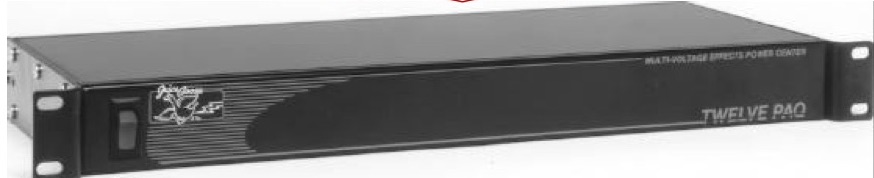
Juice Goose 12PAQ Low Voltage Power Source "Wall Wart"
Eliminator
Last Update 02/13/2026
Low voltage "Wall Wart" power sources are a necessity with a lot of
music gear, but "Wall Warts" aren't very reliable. Early in my studio design I bought this 12PAQ as a
replacement for them, and as a bonus it is a rackmount device.
Despite its rudimentary appearance, they are a very practical box.
These haven't been made for years; locating the special cables for
the low voltage outputs will be difficult, but not impossible for an
EE to build. The only wall wart eliminators you can buy today are
those designed to place on pedal boards that guitar players use,
there's no rackmount format available new.
When I built my offsite
stage rig, I needed a 12PAQ for that system so I had to buy a
used one online. It was defective so I had to repair it. These have
lethal voltages inside so don't attempt your own DIY repairs unless
you know what you are doing (I am not responsible for any bodily
harm or damage to your music gear from wiring errors). My unit used
Linear Technology LT1086 regaulators for the DC rails - with a
resistor change, it is the same IC as the more common LM317 (refer
to the datasheets).
So what is this simple simon box for? Besides the 120VAC outlets, it
supplies low voltage DC or AC power for your gear that uses wall
warts. The RJ45 ports (don't plug an ethernet cable in them!) have
taps for 18VAC, 9VAC, 9VDC, and 12VDC voltages. The special cables
were wired for positive or negative polarities to the many plugs
used for low power. The problem is, there is no standard
convention for polarity, voltage, and plug type!! You had to
pay attention to the wiring on the power port of your gear to make
sure you had the right cable. And to make things worse, those
cannon plugs are not the same outer/inner diameter from device to
device! The risk of using the wrong wiring is that you could
damage the 12PAQ.
You also had to pay attention to the total current demand of your
devices so that you don't exceed the maximum capacity for the
voltage ranges. If more than one device use a 9VDC rail - regardless
of polarity - the total current demand is the sum of all the
devices. For instance, the 9VDC and 12VDC rails each have a maximum
current capacity of 1.5 amps which isn't much!
If you understand DC polarity, voltage, current, and plug
construction you can make
your own cables, and I recommend that you test the voltage at
the plug before you use it with your gear. I also recommend labeling
any DIY cables with gear name, voltage, and polarity.
With all those cautions out of the way... this is a very practical
box for getting rid of "wall warts" that can't be secured,
especially in a rack. Another benefit is eliminating EMI hum from
all the little transformers in wall warts.

Home